Article
citation information:
Węgrzyn, T., Szczucka-Lasota,
B. Dissimilar
Ti alloys welding for the automotive and aviation sector. Scientific Journal of Silesian University of Technology. Series
Transport. 2025, 129, 283-291. ISSN:
0209-3324. DOI: https://doi.org/10.20858/sjsutst.2025.129.16
Tomasz WĘGRZYN[1], Bożena SZCZUCKA-LASOTA[2]
DISSIMILAR TI
ALLOYS WELDING FOR THE AUTOMOTIVE AND AVIATION SECTOR
Summary. Titanium alloys have an
excellent strength-to-weight ratio. Tit alloys are almost as strong as steel
but are much lighter. This translates into reduced mass in means of
transportation (e.g., aircraft, F1 cars, electric vehicles, and motorcycles),
which translates into better fuel efficiency, speed. Titanium can withstand
very high temperatures without losing its mechanical properties. As a result,
it has found applications in exhaust systems, hydraulic lines, fuel systems,
and structural elements exposed to extreme conditions. In the construction of
means of transport, two types of titanium with different structures are mainly
used (alpha titanium and alpha + beta titanium). There will certainly soon be a
need to weld these two dissimilar materials together. This is a research gap.
An absolute novelty is the attempt to weld dissimilar titanium alloys without
using a protective vacuum chamber. The purpose of this article is to establish
the correct parameters for this process.
Keywords: automotive, aviation; titanium; welding
1.
INTRODUCTION
Welding
of titanium alloys in means of transport allows for the creation of precise and
tight tubular connections, which is crucial, for example, in fuel or hydraulic
systems [1]. The high quality of titanium prevents leaks and allows maintaining
a high level of passive safety during transport. In aviation and automotive,
very strict quality and safety standards apply. Titanium welding (e.g., TIG or
MIG argon welding) meets these requirements. Maintaining high quality in
accordance with certificates is especially important in aviation (AS9100).
Titanium alloys are difficult materials to weld, but under the right
conditions, very high-quality welds can be obtained [2]. In aviation, titanium
tubes are welded into hydraulic systems, fuel lines, structural frame elements,
and pipe joints in air conditioning and cooling systems. Titanium tubes in
aviation are welded in automotive exhaust systems (e.g., in sports cars),
cooling systems (e.g., in F1), and in the frames of high-end motorcycles or
bicycles [3-4]. Titanium alloys are recommended for demanding connections,
especially in the aviation and automotive industries for pressure applications.
Typical applications include the aviation industry and pressure vessels with
components that operate at elevated temperatures (up to approx. 400–450°C). The
dissimilar welded joint between the Ti-6Al-4V titanium alloy and the
Ti-5Al-2.5Sn alloy can be used in advanced aircraft and automotive structures,
where a combination of different mechanical properties and resistance to
environmental conditions is required [5-6]. An example of an application is
titanium pipes for hydraulic, or fuel or air conditioning systems. Ti-5Al-2.5Sn
is an alloy with very good weldability, corrosion resistance, and stable
properties at elevated temperatures - ideal for thin-walled-pipes and pipes.
Ti-6Al-4V is a more durable structural alloy, used e.g., in fasteners, flanges,
connectors or brackets. In a welded joint, a pipe made of Ti-5Al-2.5Sn with a
fastener or a flange made of Ti-6Al-4V forms a lightweight, durable and
temperature and corrosion-resistant system. In the automotive industry, an
example of the use of a dissimilar connector would be the exhaust systems in
sports cars, where titanium exhaust systems are used to reduce weight and improve
resistance to high temperatures [7].
Welding
of titanium alloys is difficult and is usually carried out in a vacuum chamber,
which makes the technology of joining titanium alloys difficult [8]. The best
effects are achieved by welding with the TIG (Tungsten Inert Gas) process, less
often with MIG (Metal Inert Gas). So far, titanium welding has not been
attempted using micro-jet cooling, which could give great positive effects, as
titanium heats up very easily. Such solutions have been tested successfully for
various types of steel [9-12]. This allows for structural control and improves
joint properties and quality [13-16].
Dissimilar
titanium alloys can be welded using carefully selected parameters. The
Ti-5Al-2.5Sn alloy with an alpha structure and the Ti-6Al-4V alloy with an
alpha + beta structure were proposed as materials for testing. The dissimilar
welds were prepared using several combinations of parameters. The use of purity
shielding gases, such as helium or argon (at least 99.9%), is important to
avoid welding defects and incompabilities [17].
Helium is mainly used as an additive in an argon gas mixture [1]. Sheets should
be thoroughly cleaned before welding. When welding titanium alloys, it is
recommended to use low voltage-current parameters because the material heats up
quickly. There is a growing interest in the use of titanium
alloys and the possibilities of welding them in the construction of aircraft
and motor vehicles [18-19]. In the research it was decided not to use a
vacuum chamber, which would make the welding process much cheaper and translate
into ecological benefits in the sense of moving transport and the construction
of means of transport towards green energy [3, 17].
2. RESEARCH
MATERIALS
Ti-6Al-4V
and Ti-5Al-2,5Sn are considered difficult Ti alloys to weld, due to the
possibility of welding cracks [17]. Table 1 presents the mechanical properties
of both materials.
Tab. 1
Ti alloys and their mechanical properties
|
Ti
alloy |
UTS,
MPa |
YS,
MPa |
|
Ti-5Al-2,5Sn |
810 |
720 |
|
Ti-6Al-4V |
950 |
810 |
The titanium alloy Ti-6Al-4v steel has higher tensile strength and yield
point. This corresponds to the structure of both materials. The
Ti-5Al-2.5Sn alloy contains only the alpha phase, while the Ti-6Al-4V alloy has
the alpha phase and about 10% of the beta phase, which strengthens the
material. Table 2 shows the chemical composition of both titanium alloys.
Tab. 2
Ti alloys and their chemical composition [7]
|
Ti
alloy |
Al, % |
Sn, % |
Fe, % |
V, % |
C % |
Mo % |
Ti, % |
|
Ti-5Al-2,5Sn |
5.1 |
2.5 |
0.14 |
- |
0.04 |
- |
bal |
|
Ti-6Al-4V |
5.9 |
- |
0.19 |
4.1 |
0.02 |
0.6 |
bal |
The
main alloying elements in alpha Ti alloy are Al and Sn, and the main alloying
elements in alpha +beta Ti are Al and V which corresponds to the symbol of the
material. It was decided to check dissimilar TIG welding without chamfering.
The joint had the form of a pipe 340 mm long and 76 mm in diameter. Such pipe
diameters are found, for example, in aircraft air conditioning lines and in the
exhaust systems of sports cars. The pipe was covered on both sides
(Ti-5Al-2,5Sn from the left side and Ti-6Al-4V from the right side) with a plug
with 15 mm diameter holes (first hole for the argon inlet, and the second hole
for the shielding gas outlet). Argon was chosen as a shielding gas. The weld
was always formed as a single pass. On the inlet side, the joint was protected
by a shielding argon flow on the level of 7 dm3/min.
The following welding parameters were set:
• the welding current was varied
twice: 100 A and 110 A;
• the welding speed was varied twice:
60 mm / min and 70 mm/min;
• the outlet shielding gas flow was
varied twice: 14 dm3 / min and 16 dm3 / min.
• the arc voltage was not varied,
always 21 V.
The
joints were made with several combinations. The most important element of the
investigation was selecting 3 welding rods with a diameter of 1.6 mm:
1. ERTi-5 based on
Ti-5Al-2.5Sn chemical composition.
2. Grade 5 based on Ti-6Al-4Sn
chemical composition.
3. ERTi-2 based on pure Ti.
After the dissimilar welding, samples for mechanical
tests were prepared according to the actual standards ISO 4136 and ISO 6892.
The samples were cut perpendicular to the weld to assess the joint strength,
and then tested for the plastic properties using a bending test.
3. RESULTS AND
DISCUSSION
Welding with a rod of chemical composition similar to the
Ti-6Al-4V alloy (Grade 5), and to the chemical composition of the Ti-5Al-2.5Sn
rod (ERTi-2) did not give good results. The joints usually had defects and
welding inconsistencies. Therefore, it was decided in this article to analyze
welding using a rod (ERTi-2) with a chemical composition similar to pure
titanium. In the quality testing of titanium joints, non-destructive testing
(NDT) and destructive testing (DT) are used. The most recommended tests for
titanium joints are penetrant testing and tensile strength testing.
After the dissimilar welding process, the non-destructive
tests (NDT) were carried out, which included:
• visual test (VT) in accordance with the
requirements of EN ISO 17637 standard,
• penetration test (PT) in accordance with the
EN ISO 3452-1 standard (use penetrating agents compliant with AMS 2644,
containing minimal amounts of halides and sulfur due to the high chemical
activity of titanium). Then, some DT
testing was carried out:
• tensile strength à
PN-EN ISO 527-1 standard,
• bending test à PN-EN ISO 7438
standard,
• hardness test à ISO
6507-1 standard,
• macrostructure observations à ISO
17639:2022.
The results (8 cases) of the created dissimilar joints
are presented in Table 3.
Tab. 3
The analysis of the non-destructive tests (welding
rod ERTi-2
based on pure Ti)
|
Sample symbol |
Outlet
shielding gas flow, dm3/min |
Current, A |
Speed, mm/min |
Observation of the weld |
|
L1 |
14 |
100 |
60 |
cracks
in the weld and in the HAZ |
|
L2 |
14 |
100 |
70 |
no
defects in
weld and HAZ |
|
L3 |
14 |
110 |
60 |
cracks
in the weld and in the HAZ |
|
L4 |
14 |
110 |
70 |
cracks
in the weld and in the HAZ |
|
L5 |
16 |
100 |
60 |
no
defects in
weld and HAZ |
|
L6 |
16 |
100 |
70 |
no
defects in
weld and HAZ |
|
L7 |
16 |
110 |
60 |
cracks
in the weld and in the HAZ |
|
L8 |
16 |
110 |
70 |
no
defects in
weld and HAZ |
Based on the data in the table, it can be stated that
half of the samples were made correctly and the other half incorrectly.
Initially, it can be seen that a lower welding current and a faster welding
speed seem to be more beneficial. However, the most important thing seems to be
the correct selection of the shielding gas flow rate, which can also have an
impact on the protection of the joint against oxidation and nitriding and,
additionally, can have an impact on the cooling of the joint. The pink color indicates
the faulty joints, while the green color indicates the correct welds. The
defects occurred in the weld and in the heat-affected zone (HAZ). In order to
accurately determine the properties of the joints, destructive tests had to be
performed. The next part of the research included mechanical properties. The
tensile strength of the welds was tested using the INSTRON 3369. Only the
joints that were made correctly (L2, L5, L6, L8) were tested (marked in green
in Table 3). The results of the tensile strength (the average of 3 tests) are
shown in Table 4.
Tab. 4
Tensile strength of dissimilar titanium alloy
welds
|
Sample symbol |
UTS, MPa |
Elongation, % |
|
L2 |
702 |
9,5 |
|
L5 |
709 |
9,7 |
|
L6 |
729 |
10,5 |
|
L8 |
716 |
9,1 |
The table data shows that a high tensile strength was
obtained in all four tested cases. The highest strength was achieved for the L8
joint, which means that the linear welding energy should be limited, which
corresponds to a lower current intensity and a higher welding speed. The use of
a higher shielding gas flow rate is also beneficial. The UTS of dissimilar
titanium joints is at the level of around 700 MPa. In order to check the
plastic properties of the joints, a bending test was carried out on all dissimilar
joints that had been previously tested in the tensile strength test (taken from
Table 4). The test was realized in accordance with the EN ISO 5173 standard,
where 5 measurements were taken for each dissimilar joint, thickness both from
the root side and from the face side (Tab. 5).
No cracks were found in the weld or the HAZ
(Heat-Affected-Zone) on either the face or the root sides. Small cracks were
observed only in one case, when gas flow was less intensive (14 dm3/min).
The next part of the investigation corresponded with the microstructure
analysis. The observations were carried out on transverse sections according to
the ISO 17639:2022 standard using a Neophot microscope. The structure of the
weld L8, which allowed to obtain the highest tensile strength (UTS = 729 MPa),
is shown in Figure 1.
Tab. 5
Bending test of dissimilar titanium alloy
welds
|
Sample symbol |
Face side |
Root side |
|
L2 |
No cracks |
Small cracks |
|
L5 |
No cracks |
No cracks |
|
L6 |
No cracks |
No cracks |
|
L8 |
No cracks |
No cracks |
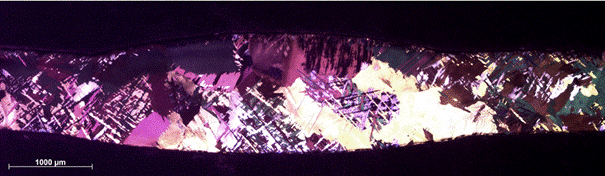
Fig. 1. The
weld structure L8, Weck’s reagent etching, Ti-5Al-2,5Sn on
the left side and Ti-6Al-4V on the right side)
From the observation of the joint, it can be concluded
that the grain is expanded in the joint in relation to the base material.
Differences in grain size in different joint zones may be the cause of welding
defects and inconsistencies observed in other joints (Table 5). The final stage of the tests included a
hardness test. The tests were performed according to the standard ISO 6507-1.
Tab. 6
Hardness test of dissimilar titanium alloy
welds
|
Ti-5Al-2,5Sn |
HAZ |
weld |
HAZ |
Ti-6Al-4V |
|
217 |
246 |
306 |
293 |
297 |
Hardness differences were observed not only between the
tested materials but also between both HAZ zones. The weld has the highest
hardness. The lack of comparable hardness may also be the reason for the
appearance of numerous welding defects and inconsistencies in other cases
(Table 6). Detailed
joint tests, especially using DT (destructive test) techniques, allow us to
understand how important it is to precisely determine the most important
welding parameters of titanium alloys, such as welding current intensity,
welding speed, and shielding gas flow intensity. Small deviations from
correctly determined parameters can translate into the appearance of welding
defects and inconsistencies.
4. CONCLUSION
The welded joint
between the Ti-6Al-4V titanium alloy and the Ti-5Al-2.5Sn alloy can be used in
advanced aerospace and automotive structures, where a combination of different
mechanical properties and resistance to environmental conditions is required.
In aviation, titanium lines are used in hydraulic and fuel systems. In
aircraft, titanium lines and tubes are used to transport fluids in hydraulic,
fuel or air conditioning systems [18,19]. In high-performance cars, titanium
exhaust systems are used to reduce weight and improve resistance to high
temperatures. This article examines the possibility of welding two dissimilar
titanium alloys. Ti-5Al-2.5Sn is an alloy with relatively good weldability,
corrosion resistance, and stable properties at elevated temperatures - ideal
for thin-walled pipes and tubes. Ti-6Al-4V is a stronger structural alloy, used
e.g. in fasteners, flanges, connectors, or brackets.
An example of the use of a
dissimilar titanium joint in aviation is the connection of a Ti-5Al-2.5Sn pipe
to a Ti-6Al-4V fastener or flange. This results in a lightweight, strong, and
temperature and corrosion resistant system. An example of the use of a
dissimilar joint in automotive engineering is the exhaust system in sports
cars. Titanium exhaust systems are used in high-performance cars to reduce
weight and improve resistance to high temperatures. The Ti-5Al-2.5Sn alloy can
be used for exhaust pipes due to its good heat resistance and weldability,
while the Ti-6Al-4V alloy can be used in flanges or mounting brackets with
increased mechanical strength. The article discusses a welded connection of a
manifold or pipe to mounting elements that combine structural durability with
heat resistance and low weight. In the research part of the article focuses on
determining the most appropriate welding parameters for both titanium alloys.
Initially, 3 welding rods with chemical compositions similar to each of the welded
titanium alloys were tested, as well as a wire with a chemical composition
similar to pure titanium. The pure titanium rod gave the best results and was
therefore selected for the basic tests described in the article. It has been
shown that due to differences in strength, hardness, and structure, it is not
easy to determine the correct process parameters. Eight different parameter
variants were tested, where the current intensity, welding speed, and the flow
rate of the gas shielding the joint were changed. It was shown that the welding
current should be low and the welding speed should be increased. It was
determined that it is important to determine the flow rate of the shielding
gas. It was shown that it is possible to make a correct pipe joint without
using a vacuum chamber. This translates into large production savings and
ecological benefits.
References
1.
Faraji A.H., C. Maletta, G. Barbieri,
F. Cognini, L. Bruno. 2021. „Numerical modeling of fluid flow, heat, and mass transfer
for similar and dissimilar laser welding of Ti-6Al-4V and Inconel 718”. International
Journal of Advanced Manufacturing Technology 114(3-4). DOI: 10.1007/s00170-021-06868-z.
2.
Li Y., Q. Liu, J. Li, C. Liu, Z. Wu. 2023. „Molecular Dynamics Simulation of Diffusion Behavior of
Ti/Al Explosive Welding Interface”. Rare Metal Materials and Engineering
52(6).
3.
Kubik A., K. Turoń, P. Folęga, F. Chen. 2023. „CO2 Emissions – Evidence from Internal Combustion and Electric Engine
Vehicles from Car-Sharing Systems”. Energies
16: 2185. DOI: 10.3390/en16052185.
4.
Turoń K., P. Czech, R.
Urbańczyk. 2018. „Bike-Sharing as an Element of Integrated Urban Transport
System”. In: Sierpiński, G. (eds). Advanced Solutions of Transport Systems for Growing
Mobility. TSTP 2017. Advances in
Intelligent Systems and Computing 631. Springer, Cham. DOI: 10.1007/978-3-319-62316-0_8.
5.
Piao Z.,
L. Zhu, X. Wang, Z. Liu, H. Jin, X. Zhang, Q. Wang, C. Kong. 2019. „Exploitation of Mold Flux for the Ti-bearing Welding Wire
Steel ER80-G”. High Temperature
Materials and Processes 38. DOI: 10.1515/htmp-2019-0040.
6.
Darabi
J., K. Ekula. “Development of a chip-integrated micro cooling device”.
Microelectronics Journal 34(11): 1067-1074. DOI:
10.1016/j.mejo.2003.09.010.
7.
Skowrońska B., T. Chmielewski, M. Baranowski, M. Kulczyk, J. Skiba. 2024. „Friction
weldability of ultrafine-grained titanium grade 2”. Journal of Advanced Joining Processes 10:
100246. DOI: 10.1016/j.jajp.2024.100246.
8.
Lee Y., J. Cheon, B.K. Min, C. Kim. 2022. „Optimization
of Gas Shielding for the Vacuum Laser Beam Welding of Ti-6Al-4V
Titanium Alloy”. Int. J. Adv. Manuf. Technol. 123(3-4): 1297-1305. DOI: 10.1007/s00170-022-10257-5.
9.
Hadryś D.
2015. “Impact load of welds after micro-jet cooling”. Archives
of Metallurgy and Materials 60(4): 2525-2528. DOI: 10.1515/amm-2015-0409.
10.
Muszynski
T., D. Mikielewicz. 2017. “Structural
optimization of microjet array cooling system”. Applied Thermal Engineering
123: 103-110. DOI: 10.1016/j.applthermaleng.2017.05.082.
11.
Celin R.,
J. Burja. 2018. “Effect
of cooling rates on the weld heat affected zone coarse grain microstructure”. Metallurgical
and Materials Engineering 24(1): 37-44.
12.
Walsh
S.M., J.P. Smith, E.A. Browne, T.W. Hennighausen, B.A. Malouin. 2018.
“Practical Concerns for Adoption of Microjet Cooling”. ASME Proceedings
Power Electronics, Energy Conversion, and Storage. DOI: 10.1115/IPACK2018-8468.
13.
Jaewsson
L., A. Kamran, P. Jwo. 2011. „Modeling of failure mode of laser welds in lap-shear
speciments of HSLA steel sheets”. Engineering Fracture Mechanics 1: 347-396.
14.
Fydrych D., J. Łabanowski, G. Rogalski. 2013. „Weldability of high strength steels in wet welding
conditions”. Polish Maritime
Research 20(2/78): 67-73. DOI: 10.2478/pomr-2013-0018.
15.
Tarasiuk W., T. Szymczak,
A. Borawski. 2020. “Investigation of surface after erosion using optical
profilometry technique”. Metrology and Measurement Systems 27(2): 265-273. DOI: 10.24425/mms.2020.132773.
16.
Rehman
A.U., N.K. Babu, M.K. Talari, Y.S. Usmani, H. Al-Khalefah. 2021. „Microstructure and mechanical properties of dissimilar
friction welding ti-6al-4v alloy to nitinol”. Metals 11(1). DOI: 10.3390/met11010109.
1.17. Skowrońska B.,
M. Bober, P. Kołodziejczak, M. Baranowski, M. Kozłowski, T. Chmielewski. 2022. “Solid-State Rotary Friction-Welded Tungsten and Mild
Steel Joints”. Appl. Sci. 12: 9034. DOI: 10.3390/app12189034.
18.
Yongshengtai. „Titanium in Aerospace: The Key to Lighter, Stronger, and
More Efficient Flight”. Yongshengtai,
2023. Available at:
https://pl.ystitanium.com/news/titanium-in-aerospace-the-key-to-lighter-stronger-and-more-efficient-flight.
19.
Shaanxi Yunzhong Metal Technology Co., Ltd. „Application
of Titanium in the Automotive Industry”. Yunzhong
Titanium, 2020. Available at:
https://pl.yunchtitanium.com/news/application-of-titanium-in-the-automotive-indu-35139644.html.
Received 27.06.2025; accepted in revised form 19.09.2025

Scientific Journal of Silesian
University of Technology. Series Transport is licensed under a Creative
Commons Attribution 4.0 International License