Article
citation information:
Melnyk,
O., Onyshchenko, S., Zhykharieva,
V., Pavlova, N., Volianska, Y., Andriievska,
V., Korobkova, O. Analytical model for ship grace-period optimization via a single window
platform: a Tianjin port case study. Scientific
Journal of Silesian University of Technology. Series Transport. 2025, 129, 147-168. ISSN: 0209-3324. DOI: https://doi.org/10.20858/sjsutst.2025.129.9
Oleksiy MELNYK[1],
Svitlana ONYSHCHENKO[2], Vlada ZHYKHARIEVA[3], Nataliia PAVLOVA4, Yana VOLIANSKA5, Vira
ANDRIIEVSKA6, Olena KOROBKOVA7
ANALYTICAL MODEL
FOR SHIP GRACE-PERIOD OPTIMIZATION VIA A SINGLE WINDOW PLATFORM: A TIANJIN PORT
CASE STUDY
Summary. The article presents an
analytical model for optimizing the "grace period" of mooring and
documentary clearance of ships in the port of Tianjin by introducing a
centralized "single window" platform. The functional roles of the key
documents - Forwarder's Cargo Receipt (FCR) and Shipping Order - regulating the
readiness of cargo for loading and confirming the completion of customs
clearance are investigated. Based on regulatory analysis, expert interviews,
and simulation modeling, critical bottlenecks in the
processes of verification and berth slot assignment are identified. A
stochastic model of the total processing time was developed, where each stage
is described as an independent, normally distributed random variable. Using
this model, the probability of exceeding the permissible processing interval is
estimated, and the feasibility of automating document flow is substantiated.
Technical and organizational solutions for implementing a unified digital
infrastructure, including standardized exchange formats, double data
validation, electronic stamping, and integration with PCS/TOS, are proposed.
This creates the basis for utilizing these results in the development of
intelligent port systems and enhancing the efficiency of logistics operations.
Keywords: port operations, project optimization, maritime logistics, berth
assignment, management system, shipping, documentation flow, freight
forwarding, cargo handling, shipping order, customs clearance, transportation
process, port community systems, stochastic process simulation, terminal
operating systems, operational efficiency, stakeholder coordination
1.
INTRODUCTION
The Port of Tianjin is
one of the largest transshipment hubs in Northern China, with millions of tons
of cargo passing through it annually. Ensuring timely delivery and mooring of
vessels in the port depends on the clarity of documentary procedures and operational
interaction between shippers, freight forwarders, customs, terminals and ship
agents. Particularly important are the FCR (Forwarders Certificate of Receipt)
and Shipping Order documents, which determine the readiness of the cargo for
loading and the port's ability to assign a berth to the vessel. In today's
environment of growing security boundaries, digitalization of the supply chain,
and increased customer expectations, improving these procedures is key to
increasing the efficiency and reliability of port operations.
The modern scientific
literature addresses the issues of digitalization and optimization of port
operations in several interrelated areas. Thus, the digital transformation in
maritime logistics is studied in the work of Zeng et al. (2025), who conducted a
systematic review of the drivers and obstacles to digitalization in maritime
logistics, finding that there is a lack of common data exchange standards and
an adequate level of digital literacy among employees. Fruth & Teuteberg
(2017) emphasize the gaps in the integration of information systems between
chain actors, while Jović et al. (2024) use the example of Croatia to
demonstrate how digital transformation increases process transparency and
reduces cargo handling time.
Blockchain and secure
document exchange have been studied by Liu (2021) and Alahmadi et al. (2022)
comparing blockchain-based platforms for the exchange of cargo documents,
proving the benefits of a distributed ledger in reducing the risk of forgery.
Chang et al. (2019), Jovanović et al. (2022), Yang (2019), and Guan et al.
(2024) summarize the possibilities of blockchain in global supply chains, while
Ni & Irannezhad (2023), Shin et al. (2023), and
Karakaş et al. (2021) emphasize its role in port ecosystem management.
Information systems
and terminal automation are presented by González-Cancelas et al. (2020) and
Camarero Orive et al. (2020) who apply SWOT analysis to assess the
digitalization and automation of container terminals in Spain. Heilig & Voß (2017) categorize information systems in ports, and Lee
et al. (2018) propose a DSS for making ship speed decisions based on large
amounts of weather data.
Decision support and
simulation in Lee et al. (2018), where the authors developed a decision support
system for optimizing ship speed using archived meteorological data, and Wang
et al. (2024) simulate the traffic of ultra-large ships in the port of Ningbo
Zhoushan, providing important insights for berth slot management.
Prediction of cargo
flows and downtime has been studied by Patil & Sahu (2016), Al-Deek (2001) and Munim et al. (2023) where they compare
regression, time series, and hybrid models to forecast container flows in key
Asian ports. Yu et al. (2025) combine graph theory and time series for a
detailed traffic forecast, while Morales-Ramírez et al. (2025) use
autoregressive models to analyze national freight
traffic. Chu et al. (2025) and Pham & Nguyen (2025) apply ensemble
approaches and machine learning to ship arrival time forecasting, and Huang et
al. (2024) apply them to terminal energy requirements. Das & Saxena (2025),
Osadume et al. (2025), Abd Rahim et al. (2024), Nwoloziri et al. (2025), and Cuong et al. (2022) study the
impact of the COVID-19 crisis on cargo flows, downtime costs, and port
recovery.
The economic impact of
the crisis is assessed in Das & Saxena (2025), which analyzes
the impact of the pandemic on freight and revenues in India, Osadume et al. (2025) on the operation of Nigerian ports,
and Nwoloziri et al. (2025) on the costs of delays in
Apapa ports. Models of risk and safety of ship operations were analyzed by Guo et al. (2024) developed an optimal
emergency resource allocation model with multi-criteria optimization, and
Darwich & Bakonyi (2025) investigated the development of port infrastructure
in East Africa. Gondia et al. (2023) apply ML methods
for dynamic risk assessment in construction, Nagurney et al. (2024) -
integrated insurance for operations during military conflicts. Melnyk et al.
(2024, 2025) serially develop concepts for the safety of cargo operations, analysis
of the structural reliability of navigation systems, and cluster analysis of
incidents. Kobets et al. (2023), Zinchenko et al. (2023, 2024) propose
automated algorithms for positioning, collision avoidance, and parametric
rolling, while Melnyk et al. (2023) evaluate the effectiveness of expert risk
management methods.
Specialized studies of
port management have been carried out by Abd Rahim et al. (2024), who studied
the impact of air pollution on the health of workers in the Klang port area.
Guo et al. (2025) forecasted water needs for irrigation of oil ports, Luidmyla et al. (2025) proposed a new approach to modeling the unloading process, Varbanets
et al. (2024) – who designed diagnostics of diesel engines of marine vessels; Zhikharieva (2025) – benchmarking of intangible assets of
shipping, and Nikolaieva et al. (2025) formalized
hybrid models of terminal management based on KPIs.
Despite a wide range
of studies on the digitalization of port processes, blockchain solutions, and
information systems in terminals, the integration of key FCR and Shipping Order
documents into a single electronic window remains underestimated in current
practice. The absence of such a solution in ports can lead to significant
delays at the stages of customs clearance and mooring assignment for ships.
Problem statement. Despite the important role of the FCR as the primary confirmation of
cargo acceptance by the forwarding agent, this document does not certify the
fact of customs clearance and readiness of the cargo for loading onto the
vessel. At Tianjin port terminals, the FCR alone does not provide a basis
for mooring slot assignment: without a stamped Shipping Order, the port cannot
verify that the cargo has cleared all customs formalities and is located in the
proper place in the terminal.
Consequently, freight
forwarders and shipowners encounter delays in the mooring process, extending
the “grace period” and resulting in additional financial costs. The lack of an
integrated data exchange system between freight forwarders, customs, the port
authority, and ship agents causes bottlenecks that have a negative impact on
port throughput and reduce the overall efficiency of the supply chain.
Purpose and objectives of the study. The purpose of this study is to analyze
the existing workflow and procedures of port operations in Tianjin, identify
bottlenecks related to the use of FCR and Shipping Order, and propose practical
digital solutions to improve them.
Objectives:
-
describe the
regulatory framework and the role of the FCR and Shipping Order in the port of
Tianjin;
-
identify the key
points of delay in the customs clearance procedure and ship mooring assignment;
-
analyze the experience of
terminals in checking the status of cargo in the port's internal systems;
-
develop
recommendations for implementing a single electronic window and automating
document exchange;
-
estimate the expected
economic effect of reducing downtime and optimizing the grace period.
The scientific novelty
of the article lies in the combination of probabilistic modeling
of the total vessel downtime (with the distribution of the constituent stages
of the document flow: FCR, customs clearance, verification, slot assignment)
with the economic function of downtime costs and the concept of implementing a
"single electronic window" for the automated exchange of FCR and
Shipping Order. For the first time, an analytical model of exceeding the
"grace period". Based on real data from the Tianjin Port, it is
proved that digital integration of document flow can provide annual savings and
increase port throughput.
2. METHODOLOGY
This study uses a combined approach that
combines qualitative and quantitative methods to comprehensively examine the
document flow process at the Port of Tianjin. First, a detailed analysis of the
regulatory framework was conducted: official instructions of the Administration
of Customs of the People's Republic of China and the Tianjin Terminal Rules
were studied, and a comparative analysis of the internal procedure cards
Forwarders Certificate of Receipt (FCR) and Shipping Order was performed. It is
important that one of the authors has more than many years of experience in
Chinese ports, including the port of Tianjin as a representative of an
international shipping company, which also allowed the authors to take into
account the practical nuances and internal logistics of port procedures and to
reproduce the formal requirements for the content and sequence of these two key
documents.
Secondly, semi-structured interviews with port
industry practitioners were organized to identify the actual processing times
and reasons for delays: interviews were conducted with three ship agents, two
representatives of forwarding companies, and a terminal operator. The
interviews provided empirical data on the time intervals between the issuance
of the FCR, the customs stamping of the Shipping Order, and the mooring slot
assignment.
And thirdly, to assess the existing IT
infrastructure of the port, a review of the Shipping Order acceptance module in
the Port Community System (PCS) was carried out. The user interface, business
logic of document processing, and data exchange mechanisms between PCS, the
customs system, and ship agents were analyzed.
Finally, in the quantitative part of the study,
a statistical analysis of ship calls during 2022-25 was performed. Based on the
collected data, the average time from the issuance of the FCR to the affixing
of the Shipping Order customs stamp, as well as the time until the actual
mooring slot is assigned, was estimated. The obtained numerical characteristics
formed the basis for further development of the analytical model and assessment
of economic losses due to delays.
3. RESULTS
The
regulatory framework and the role of FCR and Shipping Order in the port of
Tianjin
Before moving on to describe specific
procedures, it is important to outline the legal framework in which the
document flow in the port of Tianjin operates. A combination of national laws,
municipal regulations, and international guidelines forms a two-stage cargo
verification mechanism: first, the freight forwarder confirms the fact of
acceptance, and then the customs and terminal confirm the cargo's readiness for
operations.
The regulation of document flow in the port of
Tianjin is based on both general Chinese legislation and special rules of the
port administration and customs authorities. Key regulatory sources include:
1. The
Law of the People's Republic of China "On Customs Control" and bylaws
that establish requirements for the execution of cargo documents, the procedure
for their submission to the customs authorities, and the procedure for affixing
customs stamps. These provisions stipulate that only a document with a customs
stamp (Shipping Order) is recognized as an official confirmation of the
completion of the customs clearance procedures and the readiness of the cargo
for unloading or loading onto a vessel.
2. The
Tianjin Port Administration Rules approved by the Tianjin Municipal Port
Administration, which regulate the procedures for mooring assignment, berth
management, and interaction between the port authorities, terminals, ship
agents, and freight forwarders. According to these rules, terminals are obliged
to check the availability of a Shipping Order before issuing berthing
instructions.
3. The
harmonized rules of the International Federation of Freight Forwarders (FIATA)
on Forwarders Certificate of Receipt (FCR), which globally recognize the FCR as
an internal document of the forwarder to confirm the acceptance of cargo.
However, in China, the FCR, although compliant with the FIATA international
standard, is used primarily to register the fact of acceptance of cargo from
the sender but is not a basis for customs clearance or mooring assignment
(Table 1).
Tab. 1
Key regulatory sources
and their requirements
|
Regulatory
source |
Main provisions |
|
Customs Law of People’s
Republic of China |
- requirements for cargo documents; - the customs stamp on the Shipping Order is the
only proof of customs clearance and readiness for loading. |
|
Tianjin Port Administration Rules |
- list of documents for mooring assignment; - mandatory check of the Shipping Order before
issuing mooring instructions. |
|
FIATA recommendations
on FCR |
- FCR is recognized as an international standard for
confirming the acceptance of cargo by the forwarder; - in China, the FCR does not replace the Shipping
Order during processing at the port. |
Study of the role of both documents in the process
The Forwarder's Certificate of Receipt (FCR) is
a key document that serves as an internal confirmation of cargo acceptance by
the forwarder. Its main role is to record the fact of cargo transfer,
accompanied by a detailed description: the name of the sender, the number of
pieces, the nature of the cargo, the port of destination, and other mandatory
details. All this data must fully comply with the future Shipping Order
submitted to the customs authorities.
In practice, the FCR serves as the basis for the
formation of the Shipping Order: the freight forwarder uses the information
from the FCR to prepare a draft document, which is then sent for approval and
stamping by the customs. Thus, the FCR performs not only a confirmatory but
also a translational function in the customs clearance procedure, reflecting
internal control at the stage of cargo acceptance.
Table 2 shows the main tasks performed by FCR in
the process of organizing port logistics.
Tab. 2
Main tasks performed by FCR
|
Function |
Description |
|
Confirmation of
cargo acceptance |
The name of the sender, description, quantity, and
port of destination are the same details as in the Shipping Order |
|
The basis for the formation of the Shipping Order |
Based on the FCR data, the forwarder initiates
customs clearance and automatically transfers these details to the Shipping
Order project |
The role of Shipping Order in the port procedures
Shipping Order is a central document in the
system of port clearance and interaction between participants in the logistics
process. Its functional importance is as follows:
- confirmation of
customs clearance: the customs stamp on the Shipping Order certifies that the
cargo has been officially cleared and allowed for loading or unloading. This is
the only document that has legal force in confirming the completion of all customs
formalities;
- basis for planning
port operations: in the port of Tianjin, the Shipping Order is a mandatory
document for setting the time and place for mooring a vessel. Terminal
operators use it to reserve a mooring slot, which helps to avoid delays and
optimize cargo turnover;
- communication
interface: through integration with the Port Community System (PCS), the
Shipping Order is automatically sent to customs, port authorities, ship's agent
and other responsible services. This ensures the coordinated work of all
parties – from the moment the cargo arrives to the moment the vessel is
actually moored.
Thus, the Shipping Order not only formalizes the
fact of customs clearance and serves as a logistics coordinator and a digital
marker of cargo readiness for processing. Its functions are systematized in
Table 3.
Tab. 3
Main functions and designation of Shipping Order
|
Function |
Description |
|
Proof of customs
clearance |
The electronic or paper stamp of the customs office
on the Shipping Order confirms that the cargo has passed all the formalities |
|
Reasons for
mooring arrangements |
Only after successful verification of the Shipping
Order, the terminal operator reserves a berth slot and schedules maintenance |
|
Communication bridge via PCS |
The Shipping Order is sent out automatically through
the Port Community System, informing customs, the terminal and the ship's
agent about the readiness of the cargo |
Upon analyzing the
regulatory framework and the respective roles of the two documents, it becomes
clear that, while the FCR is responsible for the initial confirmation of
acceptance, it cannot form the basis for any port operations without a customs
clearance stamp. Conversely, the Shipping Order bearing
a customs stamp carries legal force for transporters and is a technical
necessity for port services. This two-step process strikes a balance
between the speed of document processing and strict compliance with Chinese
customs and legal requirements.
Thus, the combination of international FIATA
(FCR) recommendations and Chinese national requirements for the Shipping Order
creates a two-stage cargo control mechanism: the first stage confirms
acceptance, and the second stage ensures readiness for operations in the port.
This strikes a balance between the efficiency of document flow and compliance
with Chinese customs and legal requirements.
Key points of delay in the customs clearance procedure and the mooring
assignment
The main bottlenecks in the procedure of
paperwork and processing of documents that lead to delays in ship calls at the
Port of Tianjin can be grouped as follows:
1. Reconciliation
and verification of details between the FCR and the draft Shipping Order often
require additional time: if the data on the port of destination, cargo name, or
shipper does not match, the forwarder has to correct errors and resubmit the
application through the Port Community System, which adds an average of 1-2
hours of downtime.
2. Waiting
for the customs stamp is the longest stage: the customs officer checks not only
the documents but also the physical condition of the cargo, if necessary, and
then affixes the stamp. At peak times, this procedure takes an average of 4-6
hours and can extend up to 8 hours.
3. Technical
failures in the exchange of XML-packages between the customs and port systems
are likely to lead to "hangs" or format errors (duplicate files,
incorrect encoding), which makes information about the stamped Shipping Order
unavailable to the terminal for an additional 1-2 hours.
4. Upon
receipt at PCS, the Shipping Order must be manually verified by the berth
department operator: all cargo data must be checked against the terminal's
internal database (including the location of containers), which usually takes
another 1-2 hours.
Finally, only after successful verification of
the Shipping Order, the port administration generates a berth slot (lineup
instruction). During normal business hours, this process takes up to 1 hour,
while during night shifts and weekends it can take up to 3 hours. Taken
together, all these stages form a total "grace period" of 8-12 hours,
which often exceeds the regulatory limits and causes significant financial
losses due to the ship’s idle condition (Figure 1).
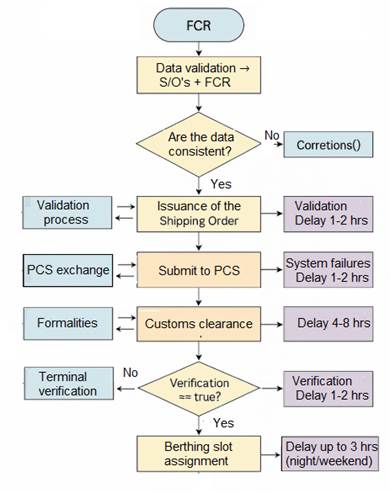
Fig. 1. Document processing
algorithm and berth slot assignment
The diagram in Figure 2 shows the step-by-step
process of Shipping Order issuance and berth slot assignment, with key points
of delay at each stage highlighted. Each block indicates the main action and
sequence of operations, and below them are possible delays (hours) with the
corresponding warning icons.
The diagram shows that the largest downtime is
during customs clearance (4-8 hours) and initial data verification (1-2 hours
for each of several steps). Smaller delays (1-2 hours) are caused by system
checks and data exchange in PCS, and during non-operational hours, an
additional 1-3 hours when assigning a berth slot. These bottlenecks should be
optimized by automating validation, increasing the throughput of exchange
systems, and introducing flexible slots to accommodate night and weekend
shifts.
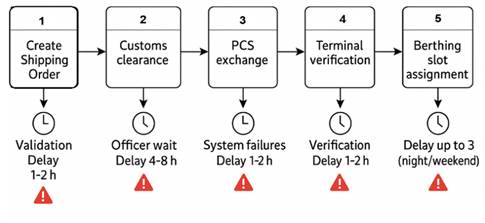
Fig. 2. Shipping Order processing process with key
points of delay
As a result, it takes an average of 8-12 hours
from the general moment of issuing the FCR to receiving the mooring
instruction; on peak days, this interval can reach 14-16 hours, which
significantly exceeds the optimal "grace period" and leads to
additional costs due to vessel downtime.
Additionally, a stochastic modeling
of the total delay of the procedure "FCR - SO - PCS - customs clearance -
mooring" was carried out. The Monte Carlo method with 10,000 iterations
was used, in which delays at each of the five stages were generated according
to uniform distributions (1-2 hours, 4-6 hours, 1-2 hours, 1-2 hours, 1-3
hours, respectively). The resulting distribution of total time allows us to
estimate the key statistical characteristics of the process and the probability
of exceeding critical time thresholds, Figure 3.
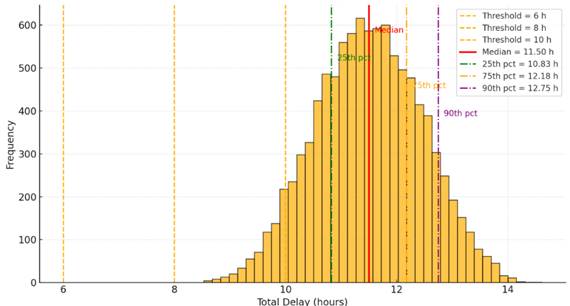
Fig. 3. Distribution of the total process delay
(histogram) with thresholds of 6 hours, 8 hours, 10 hours, as well as the
median (50%), 25%, 75%, and 90% quantiles
The range of results clearly shows that the
median total delay is approximately 11.5 hours, the 25th percentile is 10.8
hours, the 75th percentile is 12.2 hours, and the 90th percentile is 12.8
hours. Thus, the probability of exceeding the 10-hour limit reaches about 94%,
which indicates a high risk of delays beyond this threshold. The less critical
thresholds of 6 and 8 hours are almost always exceeded (with a probability of
approximately 100%), which requires optimization of key process steps to reduce
downtime and increase the efficiency of the supply chain.
Experience of terminals in checking cargo status in the port information
system
After the Shipping Order is created and stamped
by customs, an email is instantly generated in PCS and sent to the
corresponding Terminal Operating System (TOS) module of the terminal. In TOS,
the cargo receives the "Cleared" status, which makes it available for
further mooring planning. The terminal operator views the Shipping Order data,
the actual location of the container through the WMS, and additional parameters
(weight, radiological checks) in a single interface. If any field does not match,
the system displays a "yellow" warning status and blocks automatic
slot generation.
Once the Shipping Order is in the
"Cleared" status, the TOS automatically sends SMS and e-mail
notifications to the ship's agent and freight forwarder. Although the formal
SLA for status confirmation is 30 minutes, during peak periods this step takes
about 45-60 minutes. For exceptional situations when the application hangs due
to XML errors or API timeouts (1-2% of cases), operators use the manual tool
"Force Clear" after visually checking the original document.
Every day, TOS generates a report on key
metrics: the average time from "Cleared" to the issuance of a
berthing instruction (≈ 1 hour) and the share of Shipping Orders with
delays of more than 2 hours (less than 3% of cases). These indicators are analyzed weekly by the port's customer service to identify
trends and eliminate bottlenecks.
In Figure 4 shown a generalized
sequence-diagram, illustrating the main data flow between the forwarding agent,
Port Community System (PCS), Customs, and Terminal Operating System (TOS).
The diagram illustrates the sequence of digital
processing in the Port Community System (PCS), where the agent sends the FCR
and Shipping Order, the PCS requests electronic approval from customs, and then
receives back the confirmed document with a stamp. PCS then informs the TOS
system that the cargo is ready, and TOS, in turn, sends instructions for
mooring the vessel.
Field interviews and a detailed review of
internal procedures revealed that each terminal at the Port of Tianjin uses its
own Terminal Operating System (TOS) module, integrated with the port-wide Port
Community System (PCS). This combination allows for near-instant data exchange
and automation of key steps, but also reveals technical bottlenecks that need
to be addressed when optimizing processes, Table 4.
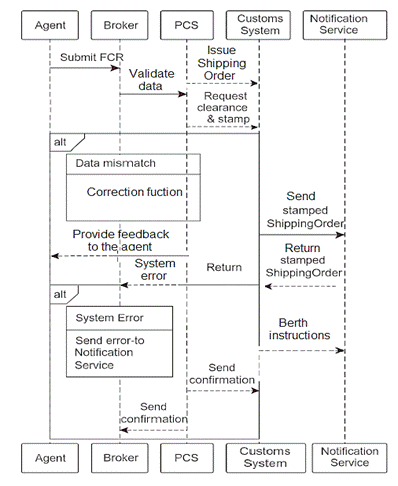
Fig. 4. FCR and Shipping Order processing in the Port
Community System (PCS)
Tab. 4
Main stages and mechanisms for checking the
status of cargo in PCS & TOS
|
№ |
Stage / Functional unit |
Description of the
operation and key indicators |
|
1 |
PCS - TOS integration |
- after the Shipping Order is stamped in PCS, a
notification is automatically sent to the terminal's TOS; - the "Cleared" status means that the
cargo and the vessel are ready for mooring. |
|
2 |
Multimodal verification |
- the TOS interface contains Shipping Order data,
container location (WMS), and the results of additional checks; - a "yellow" warning status in case of
discrepancies blocks further processing. |
|
3 |
Automated notifications and SLAs |
- SMS/email notification to the agent and forwarder
when the status is "Cleared"; - the target SLA is 30 minutes; in fact, 45-60
minutes during peak hours. |
|
4 |
Handling of exceptional situations |
- 1-2% of applications hang due to XML errors/API
timeouts; - Force Clear tool for emergency status assignment
after visual inspection. |
|
5 |
Analytics and reporting |
- daily report: time from "Cleared" to
"Berth Instruction" (≈ 1 hour), share of delays > 2 hours
(< 3%); - weekly trend analysis by the customer service to
identify and eliminate bottlenecks. |
Thus, the deep integration of PCS with TOS
allows terminals to quickly confirm the readiness of cargo, minimize human
errors, and reduce delays. At the same time, the Force Clear mechanism and
daily monitoring of key indicators ensure the stability of the process even in
the event of technical failures.
Recommendations
for the implementation of a single electronic window and automated document
exchange
To improve the document flow process, in this
case using the example of the port of Tianjin, several interrelated measures
were introduced aimed at eliminating critical bottlenecks related to the use of
FCR and Shipping Order. These measures address the technological, procedural,
and organizational aspects of creating a digital environment designed to reduce
processing time, increase transparency, and minimize human involvement in
operations.
The first step is to create a centralized Single
Window platform that will bring together all the key parties in the chain -
freight forwarders, customs, terminal operators and ship agents - in a single
digital system. This will simplify the submission of documents and reduce the
number of duplications. At the same time, standardized data formats (XML/JSON)
that comply with international protocols should be introduced using a secure
transmission channel.
An important step is the automatic creation of
Shipping Orders based on FCRs, which reduces the time for verification and
minimizes errors. Customs electronic stamping is integrated into the same
digital space, providing a transparent and consistent approval procedure. The
system must support automatic notifications and SLA compliance monitoring,
which allows for avoiding delays and responding promptly to deviations. It is
also planned to implement double data validation, both hard and soft, with
prompts for correcting errors before submission.
Ultimately, all transactions should be
documented in a secure distributed ledger to guarantee audit transparency. The
implementation occurs gradually, accompanied by compulsory staff training. The
overall framework of these steps is outlined in the table below, Table 5.
Each of the above measures is aimed at improving
a specific node of interaction between the participants in the supply chain.
For example, a centralized platform provides a single sign-on, while automatic
document generation and double validation improve accuracy. The combination of
electronic stamping with blockchain allows for complete transparency and
immutability of documentary traces, which is especially important for customs
and legal control. And the phased implementation with training guarantees smooth
adaptation of the system without disruptions in real port traffic.
Tab. 5
Key measures for implementing electronic
document exchange in the port of Tianjin
|
№ |
Component |
Description |
Functional
role |
|
1 |
Centralized
platform "Single Window" |
A single web interface for all participants to
interact: FCR, customs, TOS, agents |
Unification of processes, reduction of duplication,
centralized access |
|
2 |
Standardization of
formats (XML/JSON) and API |
Use of templates, RESTful API with TLS and OAuth 2.0 |
Seamless integration of systems, data protection |
|
3 |
Automatic creation
of Shipping Order |
Automatic copying of data from FCR to SO |
Reducing errors, speeding up document preparation |
|
4 |
Integrated electronic customs stamping |
Electronic stamping by customs in the "Single
Window" |
Refusal from papers, instant status transfer |
|
5 |
Automatic
notifications and SLA control |
SMS/email notifications, timers to meet deadlines |
Ensuring efficiency, preventive
management |
|
6 |
Double
data validation |
"Hard" - blocks, "soft" - prompts |
Improving data reliability, reducing the number of
errors |
|
7 |
Distributed transaction log |
Blockchain or DLT to record all actions |
Transparency, secure change history, audit |
|
8 |
Gradual implementation and training |
Pilot stages, trainings, feedback collection |
Minimizing implementation risks, user adaptation |
As a result of the analysis of current
bottlenecks in the FCR and Shipping Order exchange procedure in the Port of
Tianjin and the formulation of a number of recommendations aimed at creating a
single digital space for all chain participants, a structure based on the
principles of interoperability, security and increased efficiency of document
processing is presented in Figure 5.
The implementation of these recommendations will
allow particularly the Port of Tianjin to provide a fully digital, transparent,
and controlled document flow - from the moment the cargo is received by the
forwarder to the actual mooring of the vessel-reducing delays and downtime to a
minimum.
Estimation of
the expected economic effect
The analysis shows that the average vessel
demurrage rate at the Tianjin port is about 500 USD/hour. In the current
environment, due to delays in Shipping Order verification, the "grace
period" increases to 14-16 hours, while after the introduction of a single
electronic window and automation of document flow, the expected delay will be
reduced to 4-6 hours. Based on the difference of 9 hours (14-5), the savings in
downtime per ship call will be approximately USD 4,500. At 120 calls per year, this
translates into direct savings of about USD 540,000 in downtime tariffs alone.
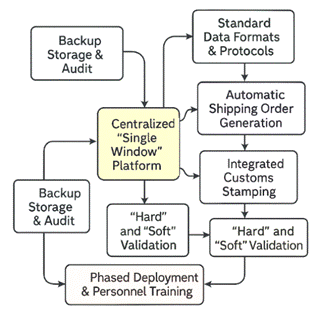
Fig. 5. Implementation roadmap for a centralized
single-window
and automated document-exchange system
In addition, reducing the 'grace period'
increases the port's overall throughput by 5-7%, equivalent to servicing an
extra 6-8 vessels per month. At an average freight rate of USD 50,000 per
vessel, calculated annually, this equates to an additional revenue of USD 3-4
million. Therefore, the total economic impact of optimizing document flow,
including direct savings on downtime and revenue generated by increased
traffic, can exceed USD 4 million per year.
In order to quantify the impact of procedural
delays on the total vessel downtime in the port of Tianjin and monitor the risk
of exceeding the "grace period," it is advisable to build an
analytical model that takes into account the individual components of the
document flow. Each of these stages - issuance of the FCR, customs clearance
and stamping of the Shipping Order, verification of documents in the port
system, and berth slot assignment - has its own average execution time and its
own variance. By combining them into an aggregate random variable, we can
estimate not only the expected downtime, but also the probability of a critical
exceedance of the permissible interval.
For an analytical description of the logistics
process of vessel registration and berthing, let us denote the main stages that
constitute the total processing time:
-
TFCR - time from
cargo reception to issuance of the Forwarder’s Cargo Receipt (FCR);
-
𝑇clear - time required for customs clearance and
stamping of the Shipping Order;
-
𝑇ver - time for document verification in PCS/TOS systems
(Port Community System / Terminal Operating System);
-
𝑇slot - time spent waiting for and being assigned a
berth slot.
The total vessel idle time associated with the
port entry process is then modeled as the sum of
these components:
 . (1)
. (1)
This equation provides a structural
decomposition of the turnaround time and serves as the basis for probabilistic modeling.
To incorporate variability and uncertainty
inherent to port operations, we treat each component 𝑇𝑖 as a random variable. Specifically, we assume
that:
-
еach 𝑇𝑖 follows a normal distribution with mean 𝜇𝑖 and variance 𝜎2𝑖;
-
variables are
mutually independent, since they reflect distinct administrative or logistical
phases.
Formally:
 . (2)
. (2)
Due to the additivity and independence of
normally distributed variables, the total processing time 𝑇total is also normally distributed, with the following
parameters:
 , (3)
, (3)
where: 𝜇𝑖 - expected
duration of stage 𝑖, 𝜎2𝑖 - variance of
stage 𝑖.
This probabilistic model enables us to quantify
both the expected delay and the dispersion around the mean, which are critical
for reliability assessment.
Ports often define a grace period threshold,
denoted 𝑇∗,
representing the maximum allowable time for documentation and berthing before
penalties or surcharges apply.
We aim to estimate the probability that the
total time exceeds this threshold:
 , (4)
, (4)
where Φ(⋅) - cumulative distribution function (CDF) of the
standard normal distribution.
This expression quantifies the risk of process
overrun, which can be used by port authorities and operators to set buffer
times, prioritize automation, or revise scheduling policies.
Beyond operational risks, excessive turnaround
time directly translates into monetary losses due to vessel idle charges. Let 𝑐rate denote the per-hour cost of vessel idle time (e.g.,
USD/hour). Then, the expected financial loss due to delays is modeled as follows:
 . (5)
. (5)
This formulation represents the expected value
of the positive deviation of total processing time above the grace period,
multiplied by the unit cost of delay. It corresponds to the area under the tail
of the distribution beyond 𝑇∗, weighted by cost.
Since 𝑇total∼𝑁(𝜇sum, 𝜎2sum), the above expectation can be numerically evaluated
or approximated using known results for truncated normal distributions.
Given empirical estimates μi and σi from observed data (e.g., from port operations logs),
this model enables the computation of:
- expected processing time;
- probability of exceeding the grace period;
- expected economic loss due to idle time.
These results can be represented as simulation
outputs to compare scenarios with and
without automation, assess the impact of parameter changes, or identify
bottlenecks.
Thus, this model can be used not only to
calculate the average downtime and determine the probability of exceeding the
optimal "grace period". It also helps to estimate economic losses and
obtain an estimate of the direct financial costs of downtime tariffs. In
practice, by substituting the empirically determined 𝜇𝑖 and 𝜎𝑖, we get the estimated cost of delays and can compare
it with the expected savings from the introduction of an electronic window and
automation of document exchange.
To illustrate how the individual stages of the
document flow procedure affect the total vessel downtime, a stack plot of the
total time and contribution of each component (FCR, customs clearance,
verification, slot assignment) was generated tо allows to clearly view of which links in the chain
become bottlenecks in different scenarios, Figure 6.
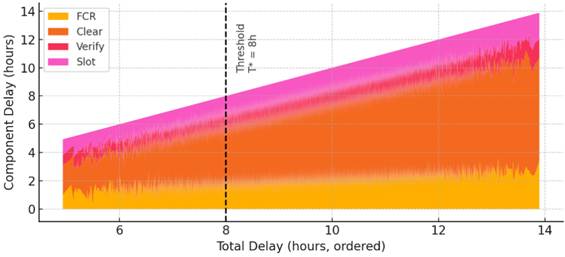
Fig. 6. Stacked component contributions to total delay
As can be seen from the graph, the largest
amount of delays is generated by the customs clearance stage (Tclear),
while the contribution of other procedures remains relatively small. The
threshold of 𝑇∗ = 8 hours
clearly separates "acceptable" downtime from those that require
urgent intervention to optimize the process.
To assess the risk of exceeding the permissible
"grace period" depending on the choice of the threshold and the
average customs clearance time, a contour graph is shown in Figure 7. It allows
us to identify the parameters under which the probability of downtime becomes
critical.
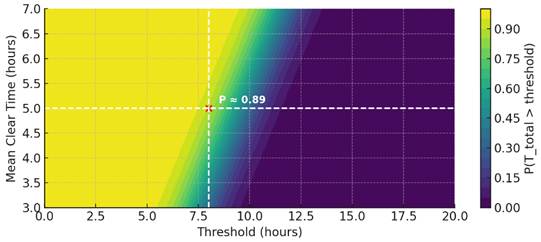
Fig. 7. Probability of exceeding the total delay
depending on the threshold value
and average customs clearance time
Probability of exceeding the threshold Ttotal
as a function of Threshold (hours) and average customs clearance time (Mean
Clear Time, hours). The white dashed lines mark the point (Threshold = 8 hours,
Mean Clear Time = 5 hours) with P ≈ 0.89.
The contour plot shows that with an average
customs clearance time of 5 hours, an increase in the threshold to 8 hours is
accompanied by a probability of more than 89% of exceeding the "grace
period". This confirms that reducing the average clearance time is an
extremely effective way to reduce the risk of downtime.
To quantify the financial losses due to port
delays, a graph was plotted in Figure 8 showing the expected cost of downtime
(USD) as a function of simultaneous changes in the threshold value and average
customs clearance time.
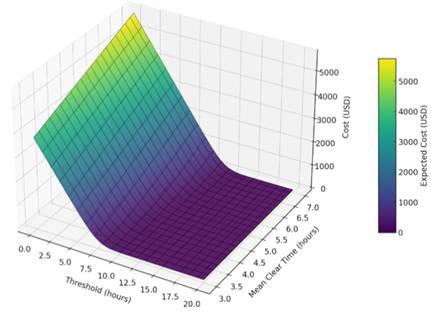
Fig. 8. Expected cost of vessel downtime (USD) as a
function of threshold (hours)
and Mean Clear Time (hours)
The graph shows that minimum costs are achieved
at a threshold of about 5-6 hours with an average customs time of ≤4
hours. On the contrary, postponement of both parameters leads to a
multiplicative increase in losses, and the cost of downtime can exceed 500,000
USD for extreme scenarios. This emphasizes the importance of simultaneously
optimizing both parameters at the port.
4. DISCUSSION
During the analysis of document flow procedures
in the Port of Tianjin, we found that the main bottlenecks are discrepancies
between the FCR and the Shipping Order, delays in customs stamping, and manual
verification of documents in PCS/TOS. Interviews with operators and statistical
analysis have shown that the average time from issuing an FCR to assigning a
berthing instruction can reach 12-16 hours, which significantly exceeds the
regulatory "grace period" and leads to financial losses for shipowners
and freight forwarders. At the same time, terminal practice has demonstrated
the high efficiency of integrated APIs and automatic notifications, but these
solutions cover only certain stages, while the lack of a single window slows
down the final processing speed.
An economic analysis shows that the
implementation of Single Window and automation of data transfer from FCR to
Shipping Order will reduce total downtime by 8-10 hours and reduce the cost of
vessel demurrage rates by approximately USD 4,500 per event. The combination of
such technical solutions as rigorous data validation, blockchain audit, and SLA
monitoring creates the preconditions not only for increasing speed but also for
improving the transparency and reliability of the entire chain of logistics operations.
5. CONCLUSION
The analysis of the document flow in the port of
Tianjin showed that the traditional two-stage mechanism - FCR as a confirmation
of cargo acceptance and stamped Shipping Order as the basis for mooring - works
correctly in the regulatory field of the PRC, but creates significant delays
(up to 14-16 hours) due to data discrepancies, waiting for customs stamping,
and manual checks in PCS and TOS. These delays lead to an increase in tariff
costs for vessel downtime and exceeding the "grace period," which
limits the port's throughput.
The proposed system of a single electronic
window with automated exchange of FCRs and Shipping Orders, standardized
exchange formats (XML/JSON, REST API), strict data validation, and blockchain
audit will reduce the total time from issuing an FCR to a berthing instruction
to 4-6 hours. This will save more than USD 540,000 in downtime tariffs and
increase throughput by 5-7%, generating a few million in additional annual
revenue.
The introduction of the Single Window,
integration of customs and port IT systems, automatic alerts, and SLA
monitoring will not only increase the efficiency and transparency of
operations, but also lay the foundation for further digitalization of the port
ecosystem - with the development of intelligent mooring planning algorithms,
what-if analytics, and smart contracts on the blockchain. In this way, Tianjin
Port will be able to strengthen its leadership position in the region and
become a model of an efficient new generation smart harbor.
References
1.
Zeng F., A. Chen, S. Xu, H.K. Chan, Li Y. 2025.
"Digitalization in the maritime logistics industry: A systematic
literature review of enablers and barriers." Journal of Marine Science
and Engineering 13(4): Article 797. https://doi.org/10.3390/jmse13040797.
2.
Fruth M., F. Teuteberg. 2017. "Digitization
in maritime logistics – What is there and what is missing?" Cogent
Business & Management 4(1). DOI:
https://doi.org/10.1080/23311975.2017.1411066.
3.
Jović M., E. Tijan, S. Aksentijević, A. Pucihar. 2024. "Assessing the Digital Transformation
in the Maritime Transport Sector: A Case Study of Croatia." Journal of
Marine Science and Engineering 12(4): 634. DOI: https://doi.org/10.3390/jmse12040634.
4.
Liu S.K. 2021. "Research on the circulation
of maritime documents based on blockchain technology." IOP Conference
Series: Earth and Environmental Science 831: 012066. DOI: https://doi.org/10.1088/1755-1315/831/1/012066.
5.
Alahmadi D., F. Baothman,
M. Alrajhi, F. Alshahrani, H. Albalawi.
2022. "Comparative analysis of blockchain technology to support digital
transformation in ports and shipping." Journal of Intelligent Systems
31(1): 55-69. DOI: https://doi.org/10.1515/jisys-2021-0131.
6.
González-Cancelas N., B. Molina Serrano, F. Soler-Flores,
A. Camarero-Orive. 2020. "Using the SWOT Methodology to Know the Scope of
the Digitalization of the Spanish Ports." Logistics 4(3): 20. DOI: https://doi.org/10.3390/logistics4030020.
7.
Heilig L., S. Voß. 2017.
"Information systems in seaports: a categorization and overview." Information
Technology and Management 18: 179-201. DOI: https://doi.org/10.1007/s10799-016-0269-1.
8.
Camarero Orive A., J.I.P. Santiago, M.M.E.-I. Corral,
N. González-Cancelas. 2020. "Strategic Analysis of the Automation of
Container Port Terminals through BOT (Business Observation Tool)." Logistics
4(1): 3. DOI: https://doi.org/10.3390/logistics4010003.
9.
Lee H., N. Aydin, Y. Choi, S. Lekhavat, Z. Irani. 2018. "A decision support system
for vessel speed decision in maritime logistics using weather archive big
data." Computers & Operations Research 98: 330-342. DOI: https://doi.org/10.1016/j.cor.2017.06.005.
10.
Patil G.R., P.K. Sahu. 2016. "Estimation of
freight demand at Mumbai Port using regression and time series models." KSCE
Journal of Civil Engineering 20(5): 2022-2032. DOI: https://doi.org/10.1007/s12205-015-0386-0.
11. Al-Deek H.M. 2001. "Which method is better for developing
freight planning models at seaports - Neural networks or multiple
regression?" Transportation Research Record 1763(1): 90-97. DOI: https://doi.org/10.3141/1763-14.
12. Munim
Z.H., C.S. Fiskin, B. Nepal, M.M.H. Chowdhury. 2023. "Forecasting
container throughput of major Asian ports using the Prophet and hybrid time
series models." The Asian Journal of Shipping and Logistics
39(2): 67-77. DOI: https://doi.org/10.1016/j.ajsl.2023.02.004.
13. Yu
H., X. Cui, X. Bai, C. Chen, L. Xu. 2025. "Incorporating graph theory and
time series analysis for fine-grained traffic flow prediction in port
areas." Ocean Engineering 335: 121693. DOI: https://doi.org/10.1016/j.oceaneng.2025.121693.
14. Morales-Ramírez
D., M.D. Gracia, J. Mar-Ortiz. 2025. "Forecasting national port cargo
throughput movement using autoregressive models." Case Studies on
Transport Policy 19: 101322. DOI:
https://doi.org/10.1016/j.cstp.2024.101322.
15. Wang
J., K. Liu, Z. Yuan, X. Yang, X. Wu. 2024. "Simulation modeling of
super-large ships traffic: Insights from Ningbo-Zhoushan Port for coastal port
management." Simulation Modelling Practice and Theory 138:
103039. DOI: https://doi.org/10.1016/j.simpat.2024.103039.
16. Chu Z., n R. Ya, S. Wang. 2025.
"Vessel arrival time to port prediction via a stacked ensemble
approach: Fusing port call records and AIS data." Transportation
Research Part C: Emerging Technologies 176: 105128. DOI: https://doi.org/10.1016/j.trc.2025.105128.
17. Huang
H., Q. Yan, Y. Yang, Y. Hu, S. Wang, Q. Yuan, X. Li, Q. Mei. 2024.
"Spatial classification model of port facilities and energy reserve
prediction based on deep learning for port management – A case study of
Ningbo." Ocean & Coastal Management 258: 107413. DOI: https://doi.org/10.1016/j.ocecoaman.2024.107413.
18. Pham
T.Y., P.N. Nguyen. 2025. "A Data-Driven framework for predicting ship
berthing time and optimizing port operations at Tan Cang Cat Lai Port,
Vietnam." Case Studies on Transport Policy 20: 101441. DOI: https://doi.org/10.1016/j.cstp.2025.101441v.
19. Das
D., A. Saxena. 2025. "Effect of COVID-19 pandemic on freight volume,
revenue and expenditure of Deendayal Port in India: An ARIMA forecasting
model." Multimodal Transportation 4(2): 100201. DOI: https://doi.org/10.1016/j.multra.2025.100201.
20. Abd
Rahim N., R. Ahmad Zaki, A. Yahya, W. Wan Mahiyuddin. 2024. "Acute effects
of air pollution on cardiovascular hospital admissions in the port district of
Klang, Malaysia: A time-series analysis." Atmospheric Environment
333: 120629. DOI: https://doi.org/10.1016/j.atmosenv.2024.120629.
21. Guo
J., Z. Jiang, J. Ying, X. Feng, F. Zheng. 2024. "Optimal allocation model
of port emergency resources based on the improved multi-objective particle
swarm algorithm and TOPSIS method." Marine Pollution Bulletin
209: 117214. DOI: https://doi.org/10.1016/j.marpolbul.2024.117214.
22. Darwich
M., J. Bakonyi. 2025. "Port infrastructures and the making of historical
time in the Horn of Africa: Narratives of urban modernity in Djibouti and
Somaliland." Cities 159: 105781. DOI: https://doi.org/10.1016/j.cities.2025.105781.
23. Guo
J., W. Wang, C.W. Kwong, Y. Peng, Z. Xia, X. Li. 2025. "Predicting water
demand for spraying operations in dry bulk ports: A hybrid approach based on
data decomposition and deep learning." Advanced Engineering
Informatics 65: 103313. DOI:
https://doi.org/10.1016/j.aei.2025.103313.
24. Cuong
T.N., H. Kim, S. You, D.A. Nguyen. 2022. "Seaport throughput forecasting
and post COVID-19 recovery policy by using effective decision-making strategy:
A case study of Vietnam ports." Computers & Industrial Engineering
168: 108102. DOI: https://doi.org/10.1016/j.cie.2022.108102.
25. Jovanović
M., N. Kostić, I.M Sebastian., T. Sedej. 2022. "Managing a
blockchain-based platform ecosystem for industry-wide adoption: The case of TradeLens." arXiv. DOI: https://doi.org/10.48550/arXiv.2209.04206.
26. Chang
Y., E. Iakovou, W. Shi. 2019. "Blockchain in global supply chains and
cross-border trade: A critical synthesis of the state of the art, challenges,
and opportunities." arXiv. DOI: https://doi.org/10.48550/arXiv.1901.02715.
27. Yang
C.-S. 2019. "Maritime shipping digitalization: Blockchain-based technology
applications, future improvements, and intention to use." Transportation
Research Part E: Logistics and Transportation Review 131: 108-117. DOI: https://doi.org/10.1016/j.tre.2019.09.020.
28. Guan
P., L.C. Wood, J.X. Wang, L.N.K. Duong. 2024. "Blockchain adoption in the
port industry: a systematic literature review." Cogent Business &
Management 11(1). DOI:
https://doi.org/10.1080/23311975.2024.2431650.
29. Gondia A., A. Moussa, M. Ezzeldin,
W. El-Dakhakhni. 2023. "Machine learning-based
construction site dynamic risk models." Technological Forecasting and
Social Change 189: 122347. DOI:
https://doi.org/10.1016/j.techfore.2023.122347.
30. Ni
L., E. Irannezhad. 2023. "Performance analysis
of LogisticChain: A blockchain platform for maritime
logistics." Computers in Industry 154: 104038. DOI: https://doi.org/10.1016/j.compind.2023.104038.
31. Shin
S., Y. Wang, S. Pettit, W. Abouarghoub. 2023.
"Blockchain application in maritime supply chain: a systematic literature
review and conceptual framework." Maritime Policy & Management
51(6): 1062-1095. DOI:
https://doi.org/10.1080/03088839.2023.2234896.
32. Karakaş
S., A.Z. Acar, B. Kucukaltan. 2021. "Blockchain
adoption in logistics and supply chain: a literature review and research
agenda." International Journal of Production Research 62: 1-24. DOI: https://doi.org/10.1080/00207543.2021.2012613.
33. Melnyk O., S. Onyshchenko, O. Onishchenko, Y. Koskina, O. Lohinov, O. Veretennik, Stukalenko O. 2024. "Fundamental
concepts of deck cargo handling and transportation safety." European
Transport - Trasporti Europei
98: 1-9. DOI: https://doi.org/10.48295/ET.2024.98.1.
34. Melnyk
O., O. Onishchenko, O. Drozhzhyn, O. Pasternak, M. Vilshanyuk, S. Zayats, Shcheniavskyi
G. 2024. "The ship safety evaluation and analysis on the multilayer model
case study." E3S Web of Conferences 501: Article 01018. DOI: https://doi.org/10.1051/e3sconf/202450101018.
35. Melnyk
O., I. Petrov, T. Melenchuk, A. Zaporozhets, S. Bugaeva, O. Rossomakha.
2025. "Causal model and cluster analysis of marine incidents: Risk factors
and preventive strategies." Studies in Systems, Decision and Control
580: 89-105. DOI: https://doi.org/10.1007/978-3-031-82027-4_6.
36. Nagurney
A., I. Pour, B. Kormych. 2024. "Integrated crop
and cargo war risk insurance: Application to Ukraine." International
Transactions in Operational Research. Advance online publication. DOI: https://doi.org/10.1111/itor.70038.
37. Kobets
V., I. Popovych, S. Zinchenko, P. Nosov, O. Tovstokoryi,
K. Kyrychenko. 2023. "Control of the pivot point position of a
conventional single-screw vessel." CEUR-WS.org 3513: 130-140. DOI: https://ceur-ws.org/Vol-3513/paper11.pdf.
38. Zinchenko S., K. Kyrychenko, O. Grosheva, P. Nosov, I. Popovych, o P. Mamenk. 2023.
"Automatic reset of kinetic energy in case of inevitable collision
of ships." IEEE Xplore: 496-500. DOI: https://doi.org/10.1109/ACIT58437.2023.10275545.
39. Zinchenko
S., O. Tovstokoryi, V. Mateichuk, P. Nosov, I. Popovych,
V. Perederyi. 2024. "Automatic prevention of the
vessel’s parametric rolling on the wave." CEUR-WS.org 3668: 235-246.
DOI: https://ceur-ws.org/Vol-3668/paper16.pdf.
40. Melnyk
O., Y. Bychkovsky, O. Onishchenko, S. Onyshchenko, Y. Volianska. 2023.
"Development the method of shipboard operations risk assessment quality
evaluation based on experts review." Studies in Systems, Decision and
Control 481: 695-710. DOI:
https://doi.org/10.1007/978-3-031-35088-7_40.
41. Zhikharieva V. 2025.
"Benchmarking of intangible assets in the shipping industry." Transactions
on Maritime Science 14(1). DOI:
https://doi.org/10.7225/toms.v14.n01.w04.
42. Aboul-Dahab
K.M. 2025. "Investigating the efficiency of the Egyptian sea port
authorities using the data envelopment analysis (DEA)." Journal of
Maritime Research 22(1): 378-384.
43. Osadume R.C., E.O. University,
D.B. Ogola. 2025. "Impact of Covid’19 pandemic on ports operations in
Nigeria." Journal of Maritime Research 22(1): 224-231.
44. Nwoloziri C.N., I.C. Nze,
A. Hlali, u T.C. Nwachukw,
T.C. Nwokedi. 2025. "Estimation of cost of delays on vessel operations in
container terminals of Apapa seaports." Journal of Maritime Research
22(1): 217-223.
45. Varbanets R., D. Minchev,
I. Savelieva, A. Rodionov, T. Mazur, S. Psariuk, V. Bondarenko. 2024.
"Advanced marine diesel engines diagnostics for IMO decarbonization
compliance." AIP Conference Proceedings 3104(1): Article 020004. DOI: https://doi.org/10.1063/5.0198828.
46. Luidmyla L.N., Y.O.
Taras, V.H. Oleksandr. 2025. "New approach in models for managing the
vessel’s unloading process." Journal of Shipping and Trade 10: 5.
DOI: https://doi.org/10.1186/s41072-025-00195-2.
47. Nikolaieva L.L., T.Y. Omelchenko,
O.V. Haichenia. 2025. "Formalization of hybrid
systems models for port terminal management with considering of key performance
indicators." Engineering Reports 7(1): Article e70004. DOI: https://doi.org/10.1002/eng2.70004.
Received 11.06.2025; accepted in revised form 15.09.2025

Scientific Journal of Silesian
University of Technology. Series Transport is licensed under a Creative
Commons Attribution 4.0 International License