Article
citation information:
Karabulut,
N.C. Application of response surface methodology to improve traffic signal
performance and minimize lane inefficiency. Scientific
Journal of Silesian University of Technology. Series Transport. 2025, 129, 97-114. ISSN: 0209-3324. DOI: https://doi.org/10.20858/sjsutst.2025.129.6
Nihat Can KARABULUT[1]
APPLICATION OF
RESPONSE SURFACE METHODOLOGY TO IMPROVE TRAFFIC SIGNAL PERFORMANCE AND MINIMIZE
LANE INEFFICIENCY
Summary. Maintaining saturation
flow at signalized intersections is crucial for both intersection capacity and
sustainable traffic management. Efficient signal systems reduce congestion,
lower emissions, and improve urban air quality. Factors such as signal timing,
traffic demand, vehicle types, and intersection design significantly impact
traffic flow efficiency. This study investigates the signal system and traffic
flow parameters affecting lane inefficiency using Response Surface Methodology
(RSM). Key factors included green time (G), the ratio of unused green time to
total green time (ϴ/G), and discharge flow rate (β), while lane
inefficiency (ẟ) served as the response variable. The full quadratic
model was identified as the best model for explaining lane inefficiency due to
its high adjusted R-squared value and low error values. The study recommends a
green time of 30 seconds and a discharge flow rate of 0.540 vehicles per second
per lane to obtain minimum lane inefficiency. These findings support
decision-makers in creating smarter, more efficient signal-controlled
intersections, ultimately contributing to sustainable urban transport
infrastructure by improving traffic flow, reducing emissions, and lowering fuel
consumption.
Keywords: fully actuated intersections, urban signal control, response surface
methodology, lane inefficiency, optimization
1.
INTRODUCTION
Efficient management of urban transportation
networks is crucial for the sustainability and livability of cities. Improving
traffic flow directly impacts the performance of transportation networks,
making the management of urban intersections essential [1]. Well-designed and
managed intersections reduce traffic congestion and increase road capacity,
enhancing urban transportation efficiency [2]. Traffic signal control is a
widely used strategy in intersection management, especially in developed cities
[3].
Traditional fixed-time signal systems often fail
to adapt to varying traffic conditions throughout the day [4]. To meet variable
traffic demands, fully actuated signal control systems are becoming more
popular. These systems dynamically adjust signal timings in real-time to
minimize queue lengths and delays [5,6], significantly improving intersection
capacity and overall traffic flow [7,8].
Optimizing intersection capacity relies on the
saturation flow rate, a key element in traffic signal system planning [9].
Vehicles discharge at the saturation flow rate until the queue is fully
dissipated [10]. The green extension period, following the clearance of queued
vehicles, greatly influences signal control effectiveness. Research shows that
discharge flow rates peak between 9 and 12 vehicles on straight lanes [11] but
decrease after 40 to 60 seconds of green time [12]. Longer queue lengths have
mixed effects on discharge flow rates [13].
Many factors affect the saturation flow rate,
including intersection geometry, lane gradient, width and markings, vehicle
composition, turning vehicles, pedestrian and bicycle activity, signal
characteristics, weather conditions, signal countdown devices, and autonomous
vehicles [14-21]. Despite extensive research, few studies focus on saturation
flow rate fluctuations at fully actuated intersections.
To address this gap, Karabulut et al. [22]
introduced a lane inefficiency parameter to provide insights into vehicle
discharge efficiency at the saturation flow rate during the green period at
fully actuated intersections. In this study, the lane inefficiency parameter
was modeled in a quadratic form using the Response Surface Methodology (RSM).
The RSM optimization technique was employed to identify optimal values of key
factors to minimize lane inefficiency. The primary aim is to minimize lane
inefficiency by understanding the factors affecting the performance of fully
actuated intersections. The novelty of this approach lies in applying RSM to
model and optimize lane inefficiency. This not only enhances the understanding
of influencing factors but also provides a practical framework for improving
intersection performance. The benefits include better traffic flow management,
reduced congestion, and enhanced road capacity at signal-controlled
intersections. The structure of this study is as follows: Section 2 outlines
the study area and data collection methods. Section 3 details the research
methodology. Section 4 presents the modeling and optimization results. Section
5 summarizes the key conclusions.
2. STUDY AREA
AND DATA
For
this study, traffic flow data were collected from two urban intersections, Expo
and Mall, in Mersin, Turkey. Table 1 shows the geometric and traffic flow
characteristics of these intersections, which are controlled by fully actuated
traffic signals. Traffic video recordings of the approach legs at these
intersections were obtained from the Transportation Department of the Mersin
Metropolitan Municipality. These recordings were made during the morning peak
hours on two weekdays under normal weather conditions. Signalization system
data, including the start and end times of the green and red periods for each
signal cycle, were also collected. During the morning peak hours, high traffic
volumes were observed on the West, East, and North approaches of the Mall
intersection, and on the West approach of the Expo intersection (see Table 2).
Approaches with low traffic volumes were not included in the study. Images
captured from the examined approaches are shown in Fig. 1.
Tab. 1
General attributes of Mall and Expo intersections
|
Attributes |
Mall |
Expo |
|
Intersection type |
Roundabout |
Four-leg |
|
Signalization type |
Fully actuated |
Fully actuated |
|
Number of approach leg |
4 |
4 |
|
Number of lanes |
3 |
3 |
|
Lane width |
3.0-3.6 m |
3.0-3.6 m |
|
Lane slope |
2% |
2% |
|
Traffic composition |
Mixed |
Mixed |
|
Pedestrian activity |
Limited |
Limited |
Tab. 2
Observed
traffic volumes
|
Intersection |
Approach |
Day 1
(07:30-09:30) |
Day 2
(07:30-09:30) |
||||
|
Left |
Middle |
Right |
Left |
Middle |
Right |
||
|
Mall |
West |
1,077 |
3,052 |
1,826 |
1,120 |
2,819 |
1,892 |
|
East |
266 |
2,192 |
1,727 |
278 |
2,314 |
1,548 |
|
|
North |
730 |
1,006 |
452 |
460 |
1,224 |
456 |
|
|
Expo |
West |
1,454 |
1,799 |
400 |
1,091 |
2,279 |
281 |
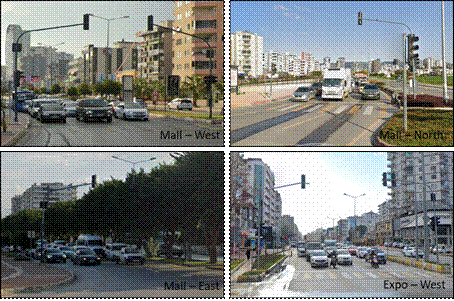
Fig.
1. Studied intersection approaches
3. METHODOLOGY
As previously mentioned, the saturation flow rate is essential for
maximizing intersection capacity and plays a vital role in the planning and
design of traffic signal systems [9]. During the queue service time, vehicles
discharge at this flow rate until the queue is completely cleared [10]. The
green extension period following the discharge of queued vehicles is critical
for the effectiveness of signal control. Ensuring optimal performance of signal
control systems involves facilitating vehicle discharges at the saturation flow
rate during this extension period.
In a previous study, Karabulut et al. [22] introduced the lane
inefficiency parameter to provide a more detailed understanding of vehicle
discharge effectiveness during the green period at intersections with fully
actuated signal systems. This parameter is calculated by comparing the
saturation flow rate with the instantaneous discharge rate for each green
period, offering a comprehensive assessment of green utilization for specific
lanes. Specifically, Fig. 2 shows the instant discharge flow rate during two
green periods where the number of queued vehicles is 11 and green time is 38
seconds. The saturation flow rates were calculated as 0.43 vehicles per second
per lane using the HCM [23] methodology. During the first green period, most
vehicles discharged at or near the saturation flow rate. However, this
efficiency was not maintained during the second green period. In this context,
the developed lane inefficiency parameter (δ) offers insights into the
effectiveness of vehicle discharge at the saturation flow rate during the green period by comparing instant
discharge rates with the saturation flow rate. The mathematical analysis
results indicated that the lane inefficiency value was 3.3% for the first green
period and 24.7% for the second. Indicating that 3.3% and 24.7% of the (G-t1)
period were used inefficiently, respectively. G is the green time and t1 is the
initial loss time which was set at 2 seconds in line with recommendations from
the HCM [23]. This situation clearly indicates that the efficiency of traffic
flow duration cannot be evaluated solely based on the saturation flow rate
value or number of discharged vehicles.
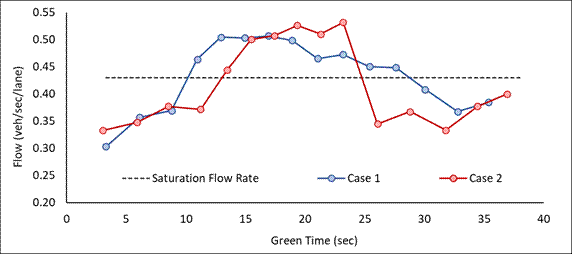
Fig. 2. Studied intersection approaches
In this study, the lane inefficiency parameter developed by Karabulut et
al. [22] was modeled using the Response Surface Methodology (RSM) technique.
Subsequently, the RSM optimization technique was employed to determine the
optimal values of key factors to minimize lane inefficiency. During the RSM
process, careful consideration was given to include both traffic flow and
traffic signal system parameters. Therefore, green time (G), the ratio of
unused green time to total green time (ϴ/G), and discharge flow rate
(β) were chosen as factors, while lane inefficiency (ẟ) was used as
the response variable (see Fig. 3).
The flowchart of the proposed methodology is presented in Fig. 3. As
seen, three factors and one response were considered. The green time (G) refers
to the portion of a signal phase in which the green signal is illuminated. The
ratio of total unused green time to green time (Ɵ/G) is the percentage
expression of the ratio of total unused green time (Ɵ) to displayed green
time (G) in a signal phase. The discharge flow rate (β) refers to the
average time headway of the vehicles traversing the stop line during the green
period. An example of table building is shown below for Tab. 1.
Central composite design (CCD) was employed to analyze the effects of the
selected factors on lane inefficiency (ẟ) response (see Fig. 3). The CCD
procedure involves systematically examining the effects of different factor
values on the response. For this purpose, mathematical models containing
linear, quadratic, and interaction terms were formulated based on field
observation data. Among these models, the one that best represents the
relationship between factors and response was selected. Subsequently, contour
graphs were generated to observe the variation of lane inefficiency (ẟ)
with different values of factors. In the final step, optimization was conducted
to determine the factor values that minimize the lane inefficiency response.
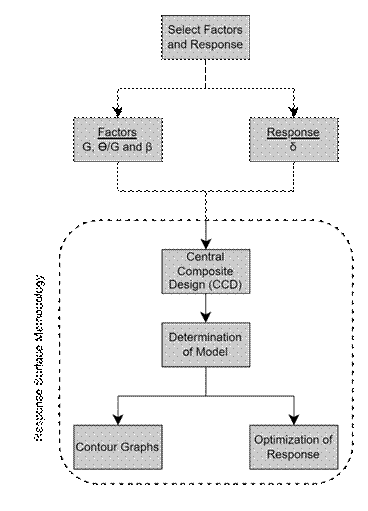
Fig. 3. The flow chart of the
proposed methodology
3.1. Response
Surface Methodology
Response Surface Methodology (RSM) is a mathematical and
statistical technique valuable for the development, enhancement, and
optimization of processes [24]. Compared to traditional experimental and
optimization methods, RSM offers numerous advantages. It efficiently extracts
significant information from a limited number of experiments using diverse
experimental designs, setting it apart from other techniques [25]. Moreover,
RSM evaluates the interaction effects of factors on the response variable, making
it an invaluable tool for modeling and optimizing problems.
RSM offers different experimental approaches, with one
standout being the central composite design (CCD). Developed by Box and Wilson
(1951), CCD is recognized as a premier second-order design in literature. It
enhances the initial first-order design, typically composed of n factors, by
incorporating additional axial points, factorial points, and center points.
This expansion allows for a thorough exploration of the response surface,
making CCD a popular choice in many studies. In a standard CCD with n factors,
the factorial points (βf), also known as cube or corner points, are coded
at levels of ±1. The total number of factorial points is determined by 2n.
Meanwhile, the center point (βc) is coded as zero and serves to evaluate
model fit. Axial points (βa) are placed at a specified distance α
from the design center in each coded factor level direction. The count of axial
points in the experimental setup can be calculated using the formula 2n. For
visual reference, Fig. 4 illustrates a CCD designed for 3 factors.
In
this study, as mentioned above, to model lane inefficiency response, three
factors were considered: green time (G), the ratio of total unused green time
to green time (Ɵ/G), and discharge flow rate (β). The CCD for
these three factors requires a total of 20 experiments, which correspond to
cycles of the signalization system. These experiments were randomly selected
from field observations and included 8 factorial points, 6 axial points, and 6
central points (see Table 3). An axial length of 1.68179 was chosen based on
the number of factorial points. Factorial points were coded with levels of ±1,
axial points with levels of ±1.68179, and center points with a level of 0. Each
factor exhibited three different levels, as depicted in Table 4.
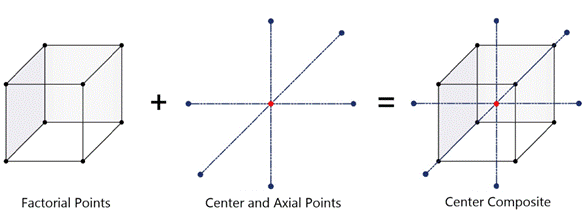
Fig. 4. CCD
for 3 factors
Tab. 3
Factors
and response values of the randomly selected experiments
|
Observations |
Model
factors values |
||||||
|
Coded value |
Uncoded value |
Response |
|||||
|
G |
ϴ/G |
β |
G |
ϴ/G |
Β |
ẟ |
|
|
1 |
-1 |
1 |
-1 |
30 |
4.48 |
0.538 |
7.22 |
|
2 |
1 |
1 |
-1 |
33 |
5.54 |
0.505 |
13.99 |
|
3 |
1 |
-1 |
1 |
33 |
5.90 |
0.499 |
16.34 |
|
4 |
1.68179 |
0 |
0 |
32 |
6.84 |
0.539 |
8.88 |
|
5 |
0 |
0 |
0 |
30 |
4.85 |
0.508 |
10.99 |
|
6 |
0 |
0 |
0 |
47 |
14.84 |
0.391 |
33.10 |
|
7 |
-1 |
-1 |
1 |
35 |
11.37 |
0.345 |
23.45 |
|
8 |
1 |
-1 |
-1 |
35 |
12.88 |
0.469 |
24.36 |
|
9 |
0 |
0 |
0 |
35 |
10.10 |
0.373 |
25.02 |
|
10 |
0 |
0 |
0 |
52 |
9.93 |
0.421 |
35.46 |
|
11 |
0 |
1.68179 |
0 |
48 |
22.20 |
0.422 |
35.68 |
|
12 |
0 |
0 |
1.68179 |
66 |
18.35 |
0.449 |
36.37 |
|
13 |
0 |
0 |
0 |
50 |
10.01 |
0.378 |
33.12 |
|
14 |
0 |
0 |
-1.68179 |
68 |
18.78 |
0.443 |
33.67 |
|
15 |
1 |
1 |
1 |
68 |
18.83 |
0.406 |
34.90 |
|
16 |
-1.68179 |
0 |
0 |
50 |
9.12 |
0.369 |
34.98 |
|
17 |
0 |
0 |
0 |
62 |
20.07 |
0.363 |
39.93 |
|
18 |
0 |
-1.68179 |
0 |
43 |
19.20 |
0.384 |
37.45 |
|
19 |
-1 |
1 |
1 |
61 |
9.51 |
0.438 |
38.35 |
|
20 |
-1 |
-1 |
-1 |
68 |
15.15 |
0.319 |
38.70 |
G (sec); ϴ/G (%); β (veh/sec/lane); ẟ (%)
Tab. 4
Level
of factors for CCD
|
Factors |
Levels |
||
|
-1.68179 |
0 |
1.68179 |
|
|
Green time (G) |
30 |
49 |
68 |
|
Total unused green time/Green time (ϴ/G) |
4.48 |
13.34 |
22.20 |
|
Discharge flow rate (β) |
0.32 |
0.43 |
0.54 |
G (sec); ϴ/G (%); β (veh/sec/lane)
4. RESULTS
In accordance with the methodology developed by Karabulut
et al. [22], lane inefficiency was calculated for 239 green periods. The
traffic flow properties of these green periods are shown in Table 5. For
example, at the West approach of the Mall intersection, the average green time
is 56 seconds, with a saturation flow rate of 0.574 vehicles per second per
lane and a discharge flow rate of 0.486 vehicles per second per lane. The
average queue length on this approach is 10.6 vehicles per cycle per lane. The traffic
composition comprises passenger cars (PC) at 92.2%, public transport (PT) at
2.4%, and heavy vehicles (HV) at 5.4%. These parameters offer valuable insights
into traffic patterns, congestion levels, and vehicle composition, aiding in
traffic management and optimization efforts.
Tab. 5
Properties
of the studied green periods
|
Intersection |
Mall |
Expo |
|||
|
Approach |
West |
East |
North |
West |
|
|
Studied green periods |
93 |
38 |
52 |
56 |
|
|
Green time (sec) |
Min. |
31 |
19 |
20 |
18 |
|
Avg. |
56 |
32 |
25 |
23 |
|
|
Max. |
72 |
35 |
30 |
33 |
|
|
Saturation flow rate (veh/sec/lane) |
Min. |
0.416 |
0.406 |
0.404 |
0.395 |
|
Avg. |
0.525 |
0.493 |
0.559 |
0.574 |
|
|
Max. |
0.741 |
0.673 |
0.735 |
0.874 |
|
|
Discharge flow rate (veh/sec/lane) |
Min. |
0.319 |
0.345 |
0.390 |
0.373 |
|
Avg. |
0.435 |
0.422 |
0.466 |
0.486 |
|
|
Max. |
0.520 |
0.492 |
0.578 |
0.522 |
|
|
Queue length (veh/cycle/lane) |
Min. |
8 |
8 |
8 |
8 |
|
Avg. |
14.0 |
11.0 |
10.0 |
10.6 |
|
|
Max. |
25 |
15 |
15 |
15 |
|
|
Traffic composition (%) |
PC |
94.3 |
92.2 |
97.3 |
92.5 |
|
PT |
4.6 |
2.4 |
2.7 |
5.1 |
|
|
HV |
1.1 |
5.4 |
0.0 |
2.4 |
|
4.1.
Response Modeling
To investigate the relationship between factors (G,
Ɵ/G, and β) and lane inefficiency (δ) (response variable), four
different RSM models have been developed (see Table 6). Note that, as mentioned
above, lane inefficiency was calculated for 239 green periods, and 20 of these
were randomly selected to be used in the developed models. Model 1 exclusively considers the linear
effects of factors on lane inefficiency (δ) response (see Eq. 1). The equation
of this linear model indicates that lane inefficiency (δ) response
increases with an increase in green time (G) and the ratio of total unused
green time to green time (Ɵ/G). Conversely, lane inefficiency (δ)
response increases as discharge flow rate (β) factors decrease. The linear
model exhibits an adjusted R-square value of 0.852 (see Table 6).
 (1)
(1)
Model 2 incorporates both the linear and square effects
of factors (see Eq. 2). The equation of the model demonstrates that the linear
and square terms of factors exert distinct effects on lane inefficiency
(δ) response. While the linear terms exhibit positive effects, the square
terms demonstrate negative effects. Model 2 achieves an adjusted R-square value
of 0.964 (see Table 6).
 (2)
(2)
Model 3 incorporates the linear and interaction effects
of factors (see Eq. 3). Both green time (G) and the ratio of total unused green
time to green time (Ɵ/G) exhibit a positive effect, whereas the discharge
flow rate (β) demonstrates a negative effect. Additionally, the
interaction terms G*(Ɵ/G) and β*(ϴ/G) show negative effects,
while the interaction term (G*β) displays a positive effect. Model 3 has
an adjusted R-squared value of 0.955 (see Table 6).
 (3)
(3)
Model 4 is a full quadratic model that includes linear,
square, and interaction terms of the factors (see Eq. 4). The linear terms
contribute positively to the lane inefficiency response, whereas the
interaction terms exert a negative impact on it. Specifically, only
(Ɵ/G)² among the squared terms demonstrates a positive effect, while
the other quadratic terms yield a negative effect. The adjusted R-squared value
of Model 4 is 0.980 (see Table 6).
 (4)
(4)
The analysis reveals that the full quadratic model
demonstrates the highest adjusted R-square value and the smallest absolute
residuals (see Table 6).
Consequently, the full quadratic was selected, as it provides the best overall
fit and statistical performance among the tested models. The ANOVA results
presented in Table 7 indicate that the terms (linear, square, and interaction)
of the full quadratic model are significant at a 95% significance level.
Examination of the residual values of the full quadratic model, depicted in
Fig. 5 and 6, shows that the predicted values closely align with the actual
values, confirming the model's effectiveness.
Tab. 6
R-square
values of the developed models
|
Model |
Model type |
R-square |
Residual |
||
|
R2 |
R2
(adj) |
Min. |
Max. |
||
|
1 |
Linear |
0.875 |
0.851 |
-5.58 |
7.31 |
|
2 |
Linear and
square |
0.974 |
0.961 |
-2.44 |
3.51 |
|
3 |
Linear and
interaction |
0.969 |
0.955 |
-3.97 |
2.91 |
|
4 |
Full
quadratic |
0.989 |
0.980 |
-2.31 |
2.36 |
Tab. 7
ANOVA
results of full quadratic model
|
Source |
Degree of
freedom |
Sum of squares
(adj) |
Mean squares
(adj) |
F-value |
p-value |
Remarks |
|
Model |
9 |
2255.89 |
250.65 |
102.20 |
0.000 |
Sig. |
|
Linear terms |
3 |
751.20 |
250.40 |
102.09 |
0.000 |
Sig. |
|
Square terms |
3 |
46.07 |
15.36 |
6.26 |
0.012 |
Sig. |
|
Interactions terms |
3 |
35.95 |
11.98 |
4.89 |
0.024 |
Sig. |
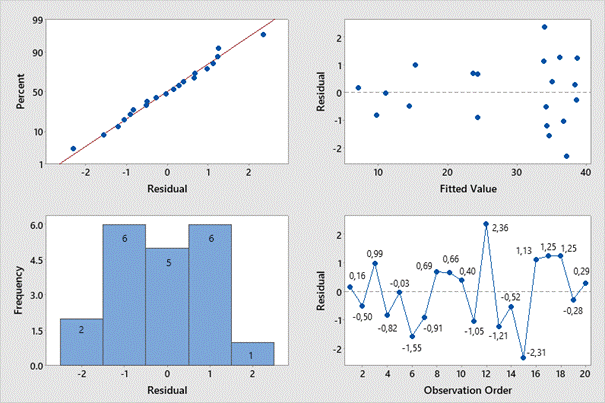
Fig. 5. Residual values of the full quadratic model
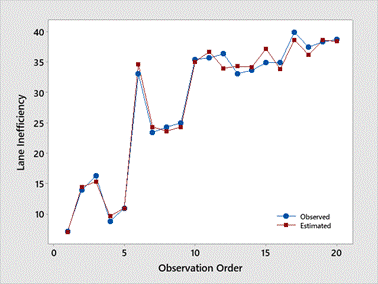
Fig. 6. Observed and estimated values
for the quadratic model
After selecting the quadratic model, contour graphs were
created to visualize how lane inefficiency (ẟ) changes with different
values of the factors. Fig. 7 illustrates the impact of green time (G) and the
ratio of total unused green time to green time (Ɵ/G) on lane inefficiency
response, with a constant discharge flow rate (β) of 0.43 vehicles per
second per lane, which is the observed average value (see Table 4). It is
evident that longer green times (G) and higher ratios of total unused green
time to green time (Ɵ/G) have adverse effects on lane inefficiency
(ẟ).
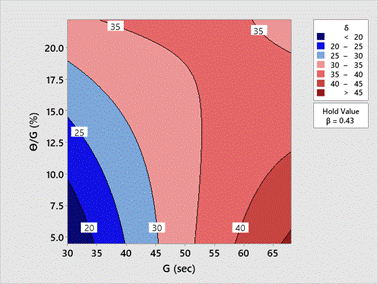
Fig. 7. Contour graphs of G and Ɵ/G
The second contour graph illustrates the effects of green
time (G) and discharge flow rate (β) on lane inefficiency response, with a
constant ratio of total unused green time to green time (Ɵ/G) at 13.34%,
which is the observed average value (see Table 4). At longer green times (G)
and lower discharge flow rate (β) values, the maximum lane inefficiency
(ẟ) response is observed (see
Fig. 8). This result reinforces the previous finding, indicating that the
longer green time (G) parameter negatively affects lane inefficiency (ẟ)
response.
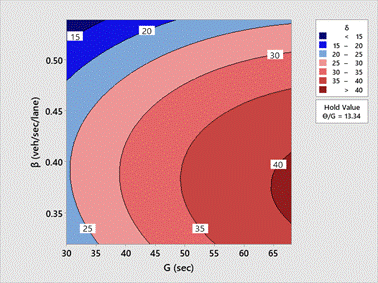
Fig. 8. Contour graphs of G
and β
The latest contour graph illustrates how the ratio of
total unused green time to green time (Ɵ/G) and the discharge flow rate
(β) influence lane inefficiency (ẟ), while keeping the green time
(G) constant at 49 seconds, which is the observed average value (see Table 4).
The highest lane inefficiency (ẟ) occurs at a higher ratio of total
unused green time to green time (Ɵ/G) and a lower discharge flow rate
(β) (see Fig. 9). It can be concluded that the discharge flow rate (β)
demonstrates an inverse relationship with lane inefficiency (ẟ) response.
This means that as the discharge flow rate decreases, lane inefficiency tends
to increase, particularly when there is a higher proportion of total unused
green time to green time.
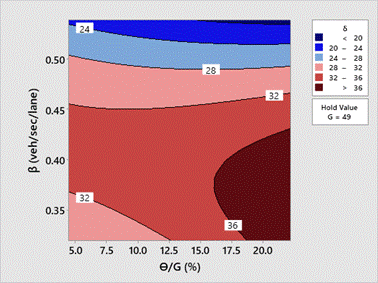
Fig. 9. Contour graphs of Ɵ/G and β
4.2.
Response Optimization
In
the final phase of the study, the Response Surface Methodology (RSM) was
employed to optimize the lane inefficiency (ẟ) response, with the aim of
minimizing it. The optimization process sought to identify factor values that
yield the lowest lane inefficiency. To achieve this, a desirability function
was defined during the optimization. The desirability function (D) is used to
assess how close the response is to the target value [24]. The highest
desirability value is 1, indicating the optimal response, while the lowest is
0. In this study, the desirability function was set to 1. Additionally, to
minimize the lane inefficiency (ẟ) response, the weights and importance
levels of the factors were also defined as 1.
The
graphs obtained for the optimum values of the factors are shown in Fig. 10.
They indicate that the lane inefficiency (ẟ) response increases as the
green time (G) and the ratio of total unused green time to green time
(Ɵ/G) increase. It also shows that the lane inefficiency (ẟ)
response decreases as the discharge flow rate (β) increases. Additionally, the
optimization graph suggests a green time of 30 seconds, a ratio of total unused
green time to green time (Ɵ/G) of 5%, and a discharge flow rate of 0.540
vehicles per second per lane to minimize lane inefficiency. By providing these
values, the lane inefficiency response will be 6.94% (see Fig. 10).
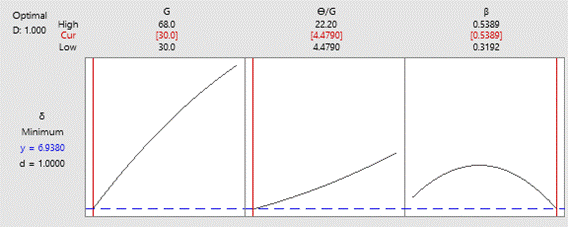
Fig. 10.
Optimization graphs of lane inefficiency (ẟ) response
5. CONCLUSIONS
Maintaining
saturation flow at signalized intersections is very important for both
intersection capacity and sustainable traffic management. Efficient signal
systems help to reduce congestion, lower emissions, and improve air quality in
cities. Factors like signal timing, traffic demand, vehicle types, and
intersection design have a big impact on traffic flow efficiency. By optimizing
these elements, traffic engineers can improve intersection performance,
resulting in smoother traffic flow and fewer delays.
Recently,
Karabulut et al. [22] introduced a new parameter called lane inefficiency to
assess how well vehicles discharge during green periods at fully actuated
intersections. In this study, signal system and traffic flow parameters
affecting lane inefficiency were studied using Response Surface Methodology
(RSM). In the developed methodology, green time (G), the ratio of unused green
time to total green time (ϴ/G),
and discharge flow rate (β)
were chosen as factors, while lane inefficiency (ẟ) was used as the
response variable. RSM was chosen because it can model and optimize the
relationship between the response and factors very well. The best model for
explaining lane inefficiency was a full quadratic model, which had the highest
adjusted R-squared value and the lowest error values.
It
is essential to operate intersections with these optimal values to reduce
inefficiency and improve performance. Minimizing the initial vehicles' lost
time in the queue, ideally losing no more than 5% of the green time, is crucial
for maintaining efficient traffic flow. It was observed that vehicle headways
and time losses increased after the 25th second of green time, leading to
reduced discharge flow rates. Consequently, the optimization process
recommended a green time of 30 seconds and a discharge flow rate of 0.540
vehicles per second per lane to minimize lane inefficiency.
The
results of this study go beyond the specific intersections analyzed, showing
that RSM is a good technique for traffic engineering. The lane inefficiency
parameter helps understand signal dynamics at fully actuated intersections and
provides recommendations for optimizing traffic signal timing, reducing
environmental impact, and maintaining saturation flow rates. This directly
helps the sustainable use of urban transport infrastructure. The study
highlights the dynamic relationship between green time and lost time, giving
practical insights for decision-makers to improve traffic flow efficiency,
reduce emissions, and lower fuel consumption. By optimizing green times, the
study achieves the goals of efficient and environmentally friendly urban
transportation. The analysis and recommendations can be adapted to different
urban contexts, promoting sustainable urban transport infrastructure on a broader
scale.
Appendix: Computing of Lane Inefficiency Parameter
In this section, lane inefficiency methodology and example calculation
are explained in detail. As an example, Fig. 2
depicted the instant discharge flow rate (βj) (veh/sec) and saturation flow rate (S) (veh/sec) during the green period.
The instant discharge flow rate (βj) (veh/sec) was calculated using the time headways of
the vehicles that pass the stop line during the green period (see Eq. 5).
 (5)
(5)
where j refers to the jth vehicle that passes the
stop line during the green period, and hj
refers to the time headway of the jth
vehicle (see Fig. 2).
The HCM method enables the calculation of the
saturation flow rate for each green period. Therefore, the saturation flow rate
(S) was calculated separately for
each green period by Eq. 6.
 (6)
(6)
where  refers to the
saturated headway (sec/veh) for the green period. The saturated headway () was calculated by Eq. 7, where n refers to the total number of vehicles in a queue, and hq refers to the time headway
of qth vehicle in a queue.
refers to the
saturated headway (sec/veh) for the green period. The saturated headway () was calculated by Eq. 7, where n refers to the total number of vehicles in a queue, and hq refers to the time headway
of qth vehicle in a queue.
 (7)
(7)
As depicted in Fig. 2, the instant discharge rate (βj) fluctuates during the green period, and inefficiency
arises when the instant discharge rate (βj) drops below the saturation flow rate (S). The total inefficiency during the
green period consists of the following three components: a) the inefficiency
resulting from the initial unused green time ( ), b) the inefficiency resulting from the unused green
time after the last vehicle passes the stop line (
), b) the inefficiency resulting from the unused green
time after the last vehicle passes the stop line ( ), c) the sum of inefficiency resulting from the low
instant discharge flow rate (
), c) the sum of inefficiency resulting from the low
instant discharge flow rate ( ). The total inefficiency is equal to:
 (8)
(8)
where  was calculated
by Eq. 9.
was calculated
by Eq. 9.
 (9)
(9)
where  refers to the
initial unused green time (sec.) for the green period
refers to the
initial unused green time (sec.) for the green period  was calculated
by Eq. 10.
was calculated
by Eq. 10.
 (10)
(10)
where  refers to the
time headway of the first vehicle in the queue.
refers to the
time headway of the first vehicle in the queue.  refers to the
initial loss time, which was taken as 2 seconds
in line with the recommendations from the HCM 2010 (TRB,
2010). The inefficiency resulting from the unused green time after the last vehicle
(
refers to the
initial loss time, which was taken as 2 seconds
in line with the recommendations from the HCM 2010 (TRB,
2010). The inefficiency resulting from the unused green time after the last vehicle
( ) was calculated by Eq. 11.
 (11)
(11)
where  refers to the unused green time after the last vehicle
(sec.) and
refers to the unused green time after the last vehicle
(sec.) and  was calculated
by Eq. 12.
was calculated
by Eq. 12.
 (12)
(12)
where G
refers to the green time (sec.), and m
is the departure volume for the green period (i.e., number of vehicles that
pass the stop line during the green period).
The sum of inefficiency resulting from the low instant
discharge flow rate () was calculated by an algorithm developed in MATLAB.
Conversely, surpassing the instantaneous discharge
rate (βj) above the saturation flow rate ( ) signifies efficiency (oversaturation). It's equally important
to take these efficient segments into account during a green period. Therefore,
clear inefficiency during the green time can be expressed by Eq. 13.
) signifies efficiency (oversaturation). It's equally important
to take these efficient segments into account during a green period. Therefore,
clear inefficiency during the green time can be expressed by Eq. 13.
 (13)
(13)
where  refers to the clear inefficiency, and
  refers to the total efficiency during the green period. The total efficiency resulting from oversaturation was calculated by an algorithm developed in MATLAB.
If Eq. 8 to 13 are closely examined, the unit of the  and
and  parameters is
vehicle. Therefore, clear inefficiency () corresponds to the number of unserved vehicles within traffic flow as
a result of unmaintainable saturation flow during the green period. Accordingly, lane inefficiency (
parameters is
vehicle. Therefore, clear inefficiency () corresponds to the number of unserved vehicles within traffic flow as
a result of unmaintainable saturation flow during the green period. Accordingly, lane inefficiency ( ) of the green period can be calculated by Eq. 14.
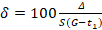 (14)
(14)
As an example, the lane inefficiency of any green
period can be calculated as follows:
The green period was 46 seconds ( ). The first vehicle in the queue traversed the stop line 2.949 seconds
after the start of green (). The green period finished 3.951 sec after the last vehicle traversed
the stop line (). The saturation flow rate of
the green period was calculated as 0.449 veh/sec/lane ().
). The first vehicle in the queue traversed the stop line 2.949 seconds
after the start of green (). The green period finished 3.951 sec after the last vehicle traversed
the stop line (). The saturation flow rate of
the green period was calculated as 0.449 veh/sec/lane ().
Therefore:
 seconds
 vehicles
 vehicles
 vehicles (calculated from MATLAB)
 vehicles
 =1.961 vehicles (calculated from
MATLAB)
=1.961 vehicles (calculated from
MATLAB)
The total efficient area is subtracted from the total inefficient area
of the cycle. The clear inefficient area of the cycle is determined.
 vehicles

22.23% of the ( ) period was used
inefficiently.
) period was used
inefficiently.
References
1.
Cipriani Ernesto, Livia Mannini, Barbara Montemarani,
Marialisa Nigro, Marco Petrelli. 2019. „Congestion pricing policies:
Design and assessment for the city of Rome, Italy”. Transport Policy 80: 127-135. ISSN: 1879-310X. DOI: https://doi.org/10.1016/j.tranpol.2018.10.004.
2.
Mondal Satyajit, Ankit Gupta. 2020. „A review of
methodological approaches for saturation flow estimation at signalized
intersections”. Canadian Journal
of Civil Engineering 47(3): 237-247. DOI: https://doi.org/10.1139/cjce-2018-0696.
3.
Wong S.C., N.N. Sze, Y.C. Li. 2007. „Contributory factors
to traffic crashes at signalized intersections in Hong Kong”. Accident
Analysis & Prevention 39(6):1107-1113. ISSN: 1879-2057. DOI: https://doi.org/10.1016/j.aap.2007.02.009.
4.
Gong Yue-Jiao, Jun Zhang. 2014. „Real-time traffic
signal control for modern roundabouts by using particle swarm
optimization-based fuzzy controller”. arXiv: 1408.0689. DOI: https://doi.org/10.48550/arXiv.1408.0689.
5.
Cai Chen, Chi Kwong Wong, Benjamin G. Heydecker. 2009.
„Adaptive traffic
signal control using approximate dynamic programming”. Transportation Research Part C:
Emerging Technologies 17(5): 456-474. ISSN: 1879-2359. DOI: https://doi.org/10.1016/j.trc.2009.04.005.
6.
Mohammed Ali Muzamil Eltejani, Akif Durdu, Seyit
Alperen Çeltek, Alper Yılmaz. 2021. „An adaptive method for traffic
signal control based on fuzzy logic with webster and modified webster formula
using SUMO traffic simulator”. IEEE Access 9: 102985-102997. ISSN: 2169-3536. DOI: https://doi.org/10.1109/ACCESS.2021.3094270.
7.
Fan Jieyu, Arsalan Najafi, Jokhio Sarang, Tian Li.
2023. „Analyzing and
Optimizing the Emission Impact of Intersection Signal Control in Mixed Traffic”. Sustainability 15(22): 16118. ISSN: 2071-1050. DOI: https://doi.org/10.3390/su152216118.
8.
Majstorović Željko, Leo Tišljarić, Edouard Ivanjko,
Tonči T. Carić. 2023. „Urban traffic signal control
under mixed traffic flows: Literature review”. Applied Sciences 13(7): 4484. ISSN: 2076-3417. DOI: https://doi.org/10.3390/app13074484.
9.
Du Yu, Anastasios Kouvelas, Wei ShangGuan, Michail A
Makridis. 2022. „Dynamic capacity estimation of mixed traffic flows
with application in adaptive traffic signal control”. Physica A: Statistical
Mechanics and its Applications 606: 128065. ISSN: 1873-2119. DOI: https://doi.org/10.1016/j.physa.2022.128065.
10.
Zheng Xing, Will Recker, Lianyu Chu. 2010. „Optimization of
control parameters for adaptive traffic-actuated signal control”. Journal of
Intelligent Transportation Systems 14(2): 95-108. DOI: https://doi.org/10.1080/15472451003719756.
11. Li Honglong, Panos D. Prevedouros. 2002. „Detailed observations
of saturation headways and start-up lost times”. Transportation Research
Record 1802(1): 44-53. ISSN: 0361-1981. DOI: https://doi.org/10.3141/1802-06.
12. Khosla Karan, James C. Williams. 2006. „Saturation flow at
signalized intersections during longer green time”. Transportation research
record 1978(1):61-67. ISSN: 0361-1981. DOI: https://doi.org/10.1177/0361198106197800109.
13. Gao L., B. Alam. 2014. „Optimal discharge speed and queue
discharge headway at signalized intersections”. In: 93rd Annual Meeting of
Transportation Research Board. Washington, DC, United States.
14. Chen Peng, Hideki Nakamura, Miho
Asano. 2011. „Saturation flow rate
analysis for shared left-turn lane at signalized intersections in Japan”. Procedia-Social and Behavioral
Sciences 16: 548-559. ISSN: 1877-0428. DOI: https://doi.org/10.1016/j.sbspro.2011.04.475.
15. Shao Chang-qiao, Jian Rong,
Xiao-ming Liu. 2011. „Study on the saturation flow rate
and its influence factors at signalized intersections in China”. Procedia-Social
and Behavioral Sciences 16: 504-514. ISSN: 1877-0428. DOI: https://doi.org/10.1016/j.sbspro.2011.04.471.
16. Potts Ingrid, John F. Ringert, Karin M. Bauer, John D. Zegeer, Douglas W. Harwood, David K. Gilmore. 2007. „Relationship of lane
width to saturation flow rate on urban and suburban signalized intersection
approaches”. Transportation
research record 2027(1): 45-51. ISSN: 0361-1981. DOI: https://doi.org/10.3141/2027-06.
17. Seyed Rasoul Davoodi, Saman
Sadeghiyan, Seyed Farzin Faezi. 2015. „The analysis the role of
motorcycles on saturation flow rates at signalized intersections in Gorgan”. Indian Journal of Science and
Technology 8(13): 1-6.
18. Wang Yi, Jian Rong, Chenjing
Zhou, Yacong Gao. 2020. „Dynamic estimation of saturation
flow rate at information-rich signalized intersections”. Information 11(4): 178. ISSN: 2078-2489. DOI: https://doi.org/10.3390/info11040178.
19. Mondal Satyajit, Ankit Gupta.
2021. „Non-linear evaluation
model to analyze saturation flow under weak-lane-disciplined mixed traffic
stream”. Transportation
Research Record 2675(8): 422-431. ISSN: 0361-1981. DOI: https://doi.org/10.1177/0361198121998370.
20. Lu Zhengyang, Tae J. Kwon, Liping Fu.
2019. „Effects of winter
weather on traffic operations and optimization of signalized intersections”. Journal of
traffic and transportation engineering 6(2): 196-208. ISSN: 2589-0379. DOI: https://doi.org/10.1016/j.jtte.2018.02.002.
21. Liu Xinyu, Jie Yu, Xiaoguang
Yang. 2021. „Diagnostic-oriented
and evaluation-driven framework for bus route performance improvement”. Journal of
Transportation Engineering, Part A: Systems 147(6): 04021030. ISSN: 2473-2893. DOI: https://doi.org/10.1061/JTEPBS.0000521.
22. Nihat Can Karabulut, Murat Ozen,
Oruc Altintasi. 2024. „Understanding the Determinants of
Lane Inefficiency at Fully Actuated Intersections: An Empirical Analysis”. Sustainability
16(2): 722. ISSN: 2071-1050.
DOI: https://doi.org/10.3390/su16020722.
23. Transportation Research Board
(TRB). 2010. Highway capacity manual (5th Edition). Washington, D.C. Transportation
Research Board, National Research Council.
24. Myers R.H., D.C. Montgomery, C.M. Anderson-Cook. 2016. Response surface methodology:
process and product optimization using designed experiments. John Wiley & Sons.
25. Baş Deniz, İsmail H. Boyacı. 2007. „Modeling and
optimization I: Usability of response surface methodology”. Journal of food engineering 78(3): 836-845. ISSN: 1873-5570. DOI: https://doi.org/10.1016/j.jfoodeng.2005.11.024.
Received 13.07.2025; accepted in revised form 05.10.2025

Scientific Journal of Silesian
University of Technology. Series Transport is licensed under a Creative
Commons Attribution 4.0 International License