Article
citation information:
Alkhayer,
L., Alzahnoun, A., Abusalem,
Z., Hazim, N. Delay overrun in road maintenance projects in Syria. Scientific Journal of Silesian University of
Technology. Series Transport. 2025, 129,
51-60. ISSN: 0209-3324. DOI: https://doi.org/10.20858/sjsutst.2025.129.3
Lana ALKHAYER[1],
Abeer ALZAHNOUN[2],
Zaydoun ABUSALEM[3], Nabil HAZIM[4]
DELAY OVERRUN IN
ROAD MAINTENANCE PROJECTS IN SYRIA
Summary. Road maintenance
project delays present serious obstacles to the development of infrastructure,
especially in nations where political and economic instability are prevalent.
This study focuses on the key reasons why road repair projects in Syria took
longer than expected between 2019 and 2022. Insufficient construction material
supply and late contractor payments are the most important delay issues
identified by the research, which is based on official records overseen by the
Public Establishment of Road Communications. The study illustrates the
intricate relationship between emergency repairs, fuel shortages,
administrative inefficiencies, and governmental requirements through a
correlation analysis of several projects. To reduce future delays in Syria's road
infrastructure sector, the findings are intended to assist stakeholders in
enhancing project planning, resource management, and execution techniques.
Keywords: time overrun, Syria, correlation study, road maintenance,
delayed payments
1. INTRODUCTION
The primary function of roads is to provide
mobility and access. Nowadays, improving road networks and connectivity is a
priority for developing countries worldwide, as road projects are a critical
element of their national budgets, where an efficient road network contributes
to economic growth and national expansion. Consequently, it is important to
commit to the scheduled time for road projects in order to meet the immediate
needs of stakeholders.
Any project to be completed successfully may
require additional time or cost. Therefore, the purpose of this study is to analyze and examine the reports taken from the public
establishment of road communications in Syria over the years 2019-2022. By
understanding the causes of delays in road maintenance work, unnecessary
obstacles and delays in both maintenance and construction projects can be
avoided. It is worth pointing out that the causes of time overruns mentioned in
these projects in this paper were the real causes that occurred and were
registered. The ranking system of the factors was identified depending on the
importance of the delay factor, and it is defined to classify the major factors
influencing time overrun.
2. LITERATURE REVIEW
It
is a challenge to complete projects on time and within the planned budget, and
it is a persistent problem around the world. Construction projects are subject
to unforeseen circumstances due to various factors, such as the existence of
varied interest groups, including the project owner, consumers, contractors,
consultants, and financiers; the complexity of construction, materials,
equipment, the climatic conditions, the political and economic situations, and
legal regulations. [1]
The
average delay for 49 Saudi Arabian road and bridge projects was 39%. The most
significant contributor to delays was land acquisition and ownership. Other
factors contributing to delays included contractors' lack of experience,
redesigns, and uncontrolled underground utilities (line services).
The
common reasons for project delays were caused by the owner contributing 53% of
the project delays, based on the study results. [2]
While
in Ethiopia, the main source of project delays was attributed to the
contractor, with 40% contributing to the project delays. The financial
problems, land acquisition, improper planning, design changes, construction
delays, shortage in providing materials and equipment by contractors, and
unfinished design are the common problems of delay and cost overrun,
respectively. [3]
Another
study in Jordan shows that topography, weather circumstances, labor supply, and varying demand were the basic reasons for
the time and cost overruns. [4]
Ibrahim
Mahamid indicates, in a study on the causes of frequent time overruns in road
construction in Palestine, that the segmentation of the West Bank, the
political circumstances, the absence of efficient machinery, inconvenient site
approaches, reasons related to the owner (for example, delayed payments), and
reasons related to the contractor (like difficulties in financing the project,
personal struggles between workers, conflict between the consultant or the
contractor and other parties, and high competition in bids) were the ten most
frequently occurring factors. [5]
In
Ghana, the causes of road construction delays are divided into
contractor-related delays, such as insufficient contractor expertise;
client-related delays, like the owner changing the work plan during
construction; and problems in financing and payment for completed work by the owner
in addition to delays in site providing and delivering to the contractor. In
addition to problems with the payments by the donor, such as providing the
project items (donor-related delays). [6]
Aksana
Jihad Mohammed shows that the main factors for delays in road construction
projects are economic crises, delayed payments, unreasonable project timelines,
and underestimating the deadline duration. Factors related to the owner, which
can be under control, come first. Then, the external factors that are beyond
control come later. [7]
In
a study on identifying the causes of suspending road projects based on a study
conducted in 25 developing countries around the world, the most common reasons
were: financial problems with banks, delayed in payments to contractors, and
delays making decisions by the owner, lowest bidder selection, lack of
equipment; insufficient contractor qualification /shortage of construction
materials/ delayed payments by the contractor, underestimating and insufficient
planning/scheduling, miscommunication between project parties, inflation,
political situation, shortage of fuel, shortage of overseas currency, import of
equipment and materials issues, environmental claims, bureaucracy and
government change of regulations, economic circumstances, and accidents during
the construction. [8]
A
study review concluded that the most significant reasons for road project
delays are design changes and contractor inefficiencies in management,
planning, and scheduling. Therefore, engaging technically qualified employees
was a suggested solution to reduce delays. While the contractor should perform
comprehensive surveys instead of relying on the report of surveys. [9]
Another
study revealed that the lack of engineers in completing comprehensive surveys
resulted in an incomplete definition of the project scope before contracting
with the contractor. Delays in removing the present public service
infrastructure from work sites of the project, problems in issuing instructions
by the client to the contractors during the implementation of the projects, and
an insufficient supply of required construction materials and equipment are the
results of a study in Blantyre, Malawi [10]. Whereas in the Woliso
Ambo Road Construction Project, the unpaid increase in the construction
materials cost, the lack of construction materials, and the lack of risk
assessment and management by consultants, in addition to overestimating or
underestimating market conditions based on the construction price indices, were
the most important negative reasons for delays, respectively. [11]
In
Afghanistan, the delay-causing factors in road projects are 1- security, such
as war and theft, and 2- contractors financial situation and insufficiency of
equipment and material. 3- territorial acquisition, 4- corruption existing in
the process of procurement, 5- delayed partial payments by owners/clients, 6-
lack of security hazards in the procurement process, 7- imprecise design and
quantity calculations/bills of materials, 8- short contractors’ experience, 9-
poorly qualified technical staff, and 10- awarding projects to the lowest bids
[12]
It
is meaningful to find out the critical factors that lead to a successful road
maintenance project, as conducted in Maysan province, where the researchers
identified three groups of success factors of road maintenance projects:
management, technical, and resources. And the outcomes show that the ten most
significant factors for the success of road maintenance projects are adequate
funds, on-time payments to contractors and employees, materials quality,
implementing advanced technology to observe or assess road deficiencies,
communication and coordination among the involved parties, accurate budget and
time estimation, selection of qualified maintenance contractors, use of modern
machinery, adequate materials and equipment, and senior management support. [13]
Due
to the circumstances that the country has been exposed to, additional reasons
have emerged over the last years that have led to time delays in the
implementation of road maintenance projects in Syria.
3. RESEARCH METHODOLOGY
Road
project contracts in Syria are divided, according to the relevant directorates
within the public establishment of road communications, into projects for
implementing new road construction and road maintenance projects, which include
periodic and ongoing maintenance, as well as improvement works for the central
road network. This research will concern road maintenance project contracts and
the reasons for delays.
In
the road maintenance sector, about 10 considerable causes were identified as
reasons for time overrun through literature in more than 25 projects in Syria
in the period of 2019-2022. The reasons that had been documented in paperwork
between the contractor and the owner were the original registered causes. The
most significant reasons that resulted in time overrun were the insufficient
supply of required materials (liquid asphalt or cement to carry out concrete
works in the contract due to security and economic problems and an
uncompensated increase in the cost of materials, which has 19.8% in the
ranking) and payment delays to contractors, which is the second main reason for
time overrun, which has 18.5% in the ranking. Delays in decision-making by the owner
are considered one of the causes of payment delays to contractors.
These
reasons are followed by additional causes of time overrun, such as shortage of
fuel, which affects the equipment work (16%); government requirements (13.6%);
accidents during the construction and the presence of obstacles not considered
during the study (17.3%); site delivery to the contractor (7.4%); and weather
conditions (3.7%).
Tab.
1
Factors Ranking Arranged Per Their Importance and Symbol
|
Factor |
Rank |
Symbol |
|
1-
Failure to provide required materials |
19.8% |
C |
|
2-
Delay in payments |
18.5% |
B |
|
3-
Emergency works |
17.3% |
E |
|
4-
shortage of fuel |
16% |
G |
|
5-
Government requirements |
13.6% |
A |
|
6-
site delivering to the contractor |
7.4% |
F |
|
7-
weather conditions |
3.7% |
H |
|
8-
Security conditions prevailing in the area |
1.2% |
D |
|
9-
Delay by the contractor in receiving the
work sites |
1.2% |
I |
|
10- Land
acquisition |
1.2% |
J |
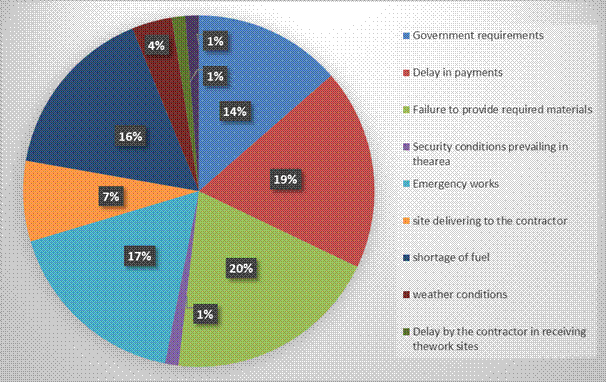
Fig. 1. Factors ranked in order of their
importance
4. RESULTS AND DISCUSSION
While Figure 1 depicts the graphical representation,
Table 1 lists the factors in order of significance. Table 2, comparing the
actual and planned times for a sample of 15 projects, shows that the average
percentage overrun time is 305%. While Table 3 shows the variables affecting
delays in projects of the study, Table 4 indicates the correlation study for
the variables affecting delays in projects.
As shown in yellow in Table 4, the most significant
factors that were associated with these projects were A-C (-0.53433), B-C
(-0.45699), E-G (-0.40319), and A-E (-0.35671). It is possible that greater
"government requirements" reduced "failure to provide required
materials" based on the negative association (-0.53433).
With values ranging from -1 to 1, correlation table 4
displays the direction and strength of linear correlations between pairs of
variables. The degree of relationship between two variables is indicated by the
correlation coefficient (r). +1 perfect positive correlation (one variable
rises proportionately when the other rises), -1 perfect negative correlation
(one variable falls proportionately when the other rises), and 0 0 to ±0.3 weak
correlation, ±0.3 to ±0.7 moderate correlation, ±0.7 to ±1 strong correlation
and no linear relationship.
The noteworthy patterns and correlations (with an
emphasis on moderate to strong associations, |r| ≥ 0.3). Variable A has a
-0.53433 moderately negative association with C. C tends to moderately decline
as A rises, indicating an inverse relationship. With B (-0.2254), E (-0.35671),
F (-0.24703), and H (-0.23857), there are weak negative correlations: A has
very weak correlations with D (0.094114) and G (-0.04012): A has nearly no
linear link with these variables, and A has tiny inverse relationships with them.
Variable B has a moderately negative correlation with C
(-0.45699), indicating a discernible inverse association between the two
variables. Weak correlations with other people: B has weak positive
correlations with E (0.061465) and F (0.105445) and weak negative correlations
with A (-0.2254), D (-0.21466), G (-0.20456), and H (-0.00369, almost zero).
Variable C has a moderately negative correlation with
both A (-0.53433) and B (-0.45699); as A or B rises, C tends to fall. Weak
correlations with others: C has a weak negative correlation (-0.23536) with F
and a weak positive correlation (0.049588) with D, E, and H. There is hardly
any correlation between C and G (0.004088).
Weak correlations with all: The largest association
(0.21466) has a weak negative correlation with B, and D has very weak
correlations with all other variables. This implies that D is mostly unaffected
by the other variables.
Variable E has a moderately negative correlation with A
(-0.35671), meaning that when A rises, E tends to fall. E and G have a
discernible inverse association, with a moderately negative correlation with G
(-0.40319). Weak correlations with other people: E has weak negative
correlations with D (-0.11194) and H (-0.05148) and weak positive correlations
with B (0.061465), C (0.04506), and F (0.090582).
Variable F: Weak correlations with all: F exhibits weak
positive correlations with B (0.105445) and E (0.090582) and weak negative
correlations with A (-0.24703), C (-0.23536), D (-0.09579), and G (-0.22316). F
is comparatively self-sufficient.
Variable G has a moderately negative correlation with E
(-0.40319), indicating a clear inverse association between the two variables.
Weak correlations with others: G has extremely weak positive correlations with
C (0.004088) and H (0.023873) and weak negative correlations with A (-0.04012),
B (-0.20456), D (-0.18256), and F (-0.22316).
The variable H shows very weak correlations with all
other variables. The highest correlation is a weak negative correlation with A
(-0.23857). H seems to be quite self-sufficient.
A and C have the strongest association (-0.53433,
moderately negative). E and G (-0.40319) and B and C (-0.45699) have other
moderate relationships.
Many variables do not have significant linear
associations with one another, as evidenced by the table's weak correlations
(|r| < 0.3). Particularly weak correlations between variables, such as D and
H, imply that they may be independent or impacted by variables not included in
this set.
The significant pattern of the study indicates that most
connections are negative. Particularly for A, C, E, and G, most correlations
are negative, meaning that when one variable rises, the others typically fall.
C is involved in several moderate connections. C is an important variable in
the dataset since it has a moderately negative correlation with both A and B.
Despite being isolated, D and H exhibit continuously low correlations,
indicating that they might not have a significant linear relationship with the
other variables.
The context of the variables (i.e., what A, B, etc.,
represent) would enable a more meaningful interpretation of these correlations.
If A is temperature and C is ice cream sales, for instance, the negative
correlation (-0.53433) may indicate that ice cream sales are decreased by
higher temperatures (perhaps because of melting or seasonal impacts).
This indicates that the factors "government
requirements" and "failure to provide required materials" are
correlated and have a largely negative impact on each other. "Delay in
payments" and "failure to provide required materials" are
correlated and have the second-highest impact on each other, followed by
"emergency works" and "shortage of fuel," which are
correlated and have the third-highest impact on each other. Finally,
"government requirements" are correlated and have the fourth-highest
impact on the factor "emergency works," all of which contribute to
the study's project delays. The correlation study indicates that the other
factors have their own effects on the delay, mostly as individuals, and are not
related to or correlated with one another.
Tab. 2
Planned and actual times for 15 projects.
(The average percentage overrun time is 305%)
|
Project |
Planned Time (day)
|
Actual Time (day)
|
Delay period (day)
|
Time overrun
% |
|
|
1 |
120 |
940 |
820 |
683 |
|
|
2 |
120 |
545 |
425 |
354 |
|
|
3 |
120 |
725 |
605 |
504 |
|
|
4 |
75 |
210 |
135 |
180 |
|
|
5 |
180 |
300 |
120 |
67 |
|
|
6 |
120 |
390 |
270 |
225 |
|
|
7 |
250 |
1160 |
910 |
364 |
|
|
8 |
150 |
725 |
575 |
383 |
|
|
9 |
150 |
560 |
410 |
273 |
|
|
10 |
120 |
725 |
605 |
504 |
|
|
11 |
120 |
270 |
150 |
125 |
|
|
12 |
180 |
845 |
665 |
369 |
|
|
13 |
120 |
665 |
545 |
454 |
|
|
14 |
150 |
240 |
90 |
60 |
|
|
15 |
120 |
155 |
35 |
29 |
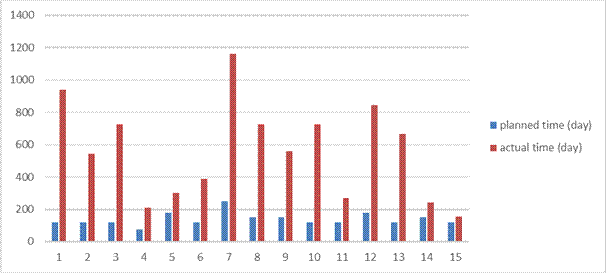
Fig. 2. The planned time and actual
time for the examined projects
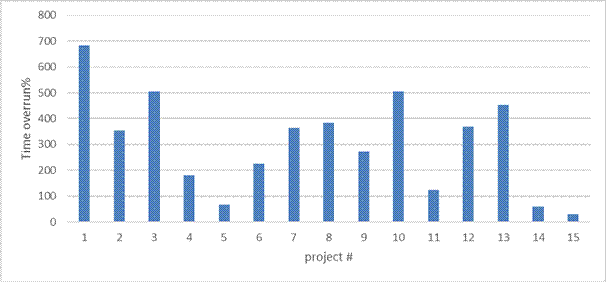
Fig. 3. Time overrun for the examined
projects
Tab. 3
Variables Affecting Delays in Projects of the Study
|
Variable |
A |
B |
C |
D |
E |
F |
G |
H |
I |
J |
|
1 |
60 |
40 |
0 |
0 |
0 |
0 |
0 |
0 |
0 |
0 |
|
2 |
30 |
0 |
40 |
30 |
0 |
0 |
0 |
0 |
0 |
0 |
|
3 |
20 |
20 |
30 |
0 |
5 |
20 |
15 |
0 |
0 |
0 |
|
4 |
50 |
30 |
0 |
0 |
0 |
0 |
20 |
0 |
0 |
0 |
|
5 |
0 |
70 |
0 |
0 |
30 |
0 |
0 |
0 |
0 |
0 |
|
6 |
0 |
40 |
0 |
0 |
0 |
60 |
0 |
0 |
0 |
0 |
|
7 |
25 |
25 |
30 |
0 |
0 |
0 |
20 |
0 |
0 |
0 |
|
8 |
0 |
0 |
80 |
0 |
20 |
0 |
0 |
0 |
0 |
0 |
|
9 |
0 |
20 |
25 |
0 |
15 |
10 |
20 |
10 |
0 |
0 |
|
10 |
0 |
20 |
60 |
0 |
0 |
0 |
20 |
0 |
0 |
0 |
|
11 |
0 |
20 |
60 |
0 |
0 |
0 |
20 |
0 |
0 |
0 |
|
12 |
0 |
20 |
60 |
0 |
0 |
0 |
20 |
0 |
0 |
0 |
|
13 |
0 |
20 |
30 |
0 |
0 |
10 |
20 |
20 |
0 |
0 |
|
14 |
0 |
60 |
40 |
0 |
0 |
0 |
0 |
0 |
0 |
0 |
|
15 |
0 |
0 |
60 |
0 |
40 |
0 |
0 |
0 |
0 |
0 |
|
16 |
0 |
30 |
40 |
0 |
0 |
0 |
30 |
0 |
0 |
0 |
|
17 |
0 |
30 |
10 |
0 |
40 |
20 |
0 |
0 |
0 |
0 |
|
18 |
30 |
40 |
15 |
0 |
0 |
0 |
15 |
0 |
0 |
0 |
|
19 |
100 |
0 |
0 |
0 |
0 |
0 |
0 |
0 |
0 |
0 |
|
20 |
0 |
0 |
60 |
0 |
0 |
0 |
40 |
0 |
0 |
0 |
|
21 |
20 |
0 |
50 |
0 |
0 |
10 |
20 |
0 |
0 |
0 |
|
22 |
0 |
20 |
60 |
0 |
5 |
0 |
0 |
15 |
0 |
0 |
|
23 |
60 |
0 |
40 |
0 |
0 |
0 |
0 |
0 |
0 |
0 |
|
24 |
0 |
0 |
60 |
0 |
15 |
25 |
0 |
0 |
0 |
0 |
|
25 |
50 |
0 |
0 |
0 |
0 |
0 |
50 |
0 |
0 |
0 |
Tab. 4
Correlation study for the variables affecting delays in projects
|
Variables |
A |
B |
C |
D |
E |
F |
G |
H |
|
A |
1 |
|||||||
|
B |
-0.2254 |
1 |
||||||
|
C |
-0.53433 |
-0.45699 |
1 |
|||||
|
D |
0.094114 |
-0.21466 |
0.049588 |
1 |
||||
|
E |
-0.35671 |
0.061465 |
0.04506 |
-0.11194 |
1 |
|||
|
F |
-0.24703 |
0.105445 |
-0.23536 |
-0.09579 |
0.090582 |
1 |
||
|
G |
-0.04012 |
-0.20456 |
0.004088 |
-0.18256 |
-0.40319 |
-0.22316 |
1 |
|
|
H |
-0.23857 |
-0.00369 |
0.070201 |
-0.07239 |
-0.05148 |
0.012527 |
0.023873 |
1 |
5. CONCLUSIONS
Most road maintenance projects in Syria are characterized
as delayed, particularly in the past ten years, according to an analysis of
reports and documents for multiple projects.
The results show that the critical factors are failure to
provide required materials due to the political, economic, and security
conditions that affected the country; delay in payments; accidents during the
construction; and the presence of obstacles not considered during the study. In
addition to the shortage of fuel and government requirements. It is illustrated
that between the estimated and final time, there is a critical discrepancy,
from 29% to 683%, with an average of 305%.
The factors "government requirements" and
"failure to provide required materials" are correlated and have a
largely negative impact on each other. "Delay in payments" and
"failure to provide required materials" are correlated and have the
second-highest impact on each other, followed by "emergency works"
and "shortage of fuel," which are correlated and have the
third-highest impact on each other. Finally, "government
requirements" are correlated and have the fourth-highest impact on the
factor "emergency works," all of which contribute to the study's
project delays. The correlation study indicates that the other factors have
their own effects on the delay, mostly as individuals, and are not related to
or correlated with one another.
The findings of this study show similarities with the
reviewed literature, particularly in developing nations.
References
1.
Subedi D.P., B.R. Joshi. 2020. „Identification of causes of delay in road
projects: Cases in Gandaki Province, Nepal”. Saudi
Journal of Engineering and Technology
5(5): 231-243. ISSN: 2415‑6272.
DOI: 10.36348/sjet.2020.v05i05.004.
2.
Elawi G.S.A., M. Algahtany,
D. Kashiwagi. 2016. „Owners’ perspective of
factors contributing to project delay: case studies of road and bridge projects
in Saudi Arabia”. Procedia Engineering 145: 1402-1409. ISSN: 1877‑7058.
3.
Durdyev S. 2017. „Factors influencing time and cost overruns in
road construction projects: Addis Ababa, Ethiopian scenario: review paper”. Engineering,
Construction and Architectural Management
2(2): 393-406. ISSN: 0969‑9988.
4.
Al‑Hazim N., Z.A. Salem.
2015. „Delay and cost overrun in road construction projects in Jordan”. International
Journal of Engineering & Technology
4(2): 288-293. ISSN: 2319‑8613.
5.
Mahamid I. 2013. „Common risks affecting time overrun in road
construction projects in Palestine: Contractors’ perspective”. Australasian
Journal of Construction Economics and Building
13(2): 45-53. ISSN: 1449‑2724.
6.
Amoatey C.T., A.N.O. Ankrah.
2017. „Exploring critical road project delay factors in Ghana”. Journal
of Facilities Management
15(2): 110-127. ISSN: 1472‑5967.
7.
Mohammed A.J. 2023.
„Evaluation of time overruns and time management techniques in road
construction projects in Erbil city”. Journal of
Engineering and Sustainable Development
27(4): 499-510. ISSN: 2521‑7594.
8.
Rivera L., H. Baguec Jr, C. Yeom. 2020. „A study on causes of delay in road
construction projects across 25 developing countries”. Infrastructures 5(10): 84. ISSN: 2524‑3903.
DOI: 10.3390/infrastructures5100084.
9.
Kumar M., S. Kumari.
2025. „Causes of delays in road construction projects: a systematic review”. Journal
of Financial Management of Property and Construction 30(2): 256-294. ISSN: 1366‑4387.
DOI: 10.1108/JFMPC‑01‑2023‑0004.
10.
Mwamvani H.D.J., C. Amoah,
E. Ayesu‑Koranteng.
2022. „Causes of road projects’ delays: a case of Blantyre, Malawi”. Built
Environment Project and Asset Management
12(2): 293-308. ISSN: 2044‑124X.
11.
Berta K.K., M. Tesfaye.
2025. „Determinants of road construction project delay in the case of Woliso-Ambo road construction”. Scientific
Reports 15(1): 5405. ISSN: 2045‑2322.
DOI: 10.1038/s41598‑025‑5405‑x.
12.
Karimi S., P. Piroozfar.
2022. „Exploring causes of delays in national road and highway projects in
developing construction economy”. Journal of
Engineering, Project and Production Management
12(2): 137. ISSN: 2146‑4496.
13.
Ghanbari M., Z.K. Hasani.
2024. „Key success factors in road maintenance management projects (A case
study of Maysan Province, Iraq)”. IIUM
Engineering Journal
25(1): 102-114. ISSN: 1823‑7822.
Received 19.07.2025; accepted in revised form 24.10.2025

Scientific Journal of Silesian
University of Technology. Series Transport is licensed under a Creative
Commons Attribution 4.0 International License